Samsung and Hyundai ramp up high-tech spending, from new chip lines to record AI investments
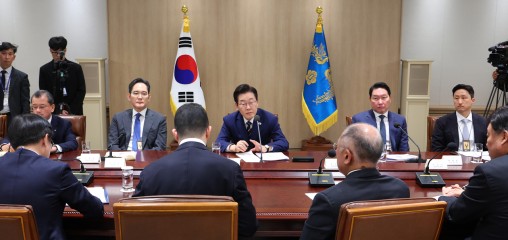
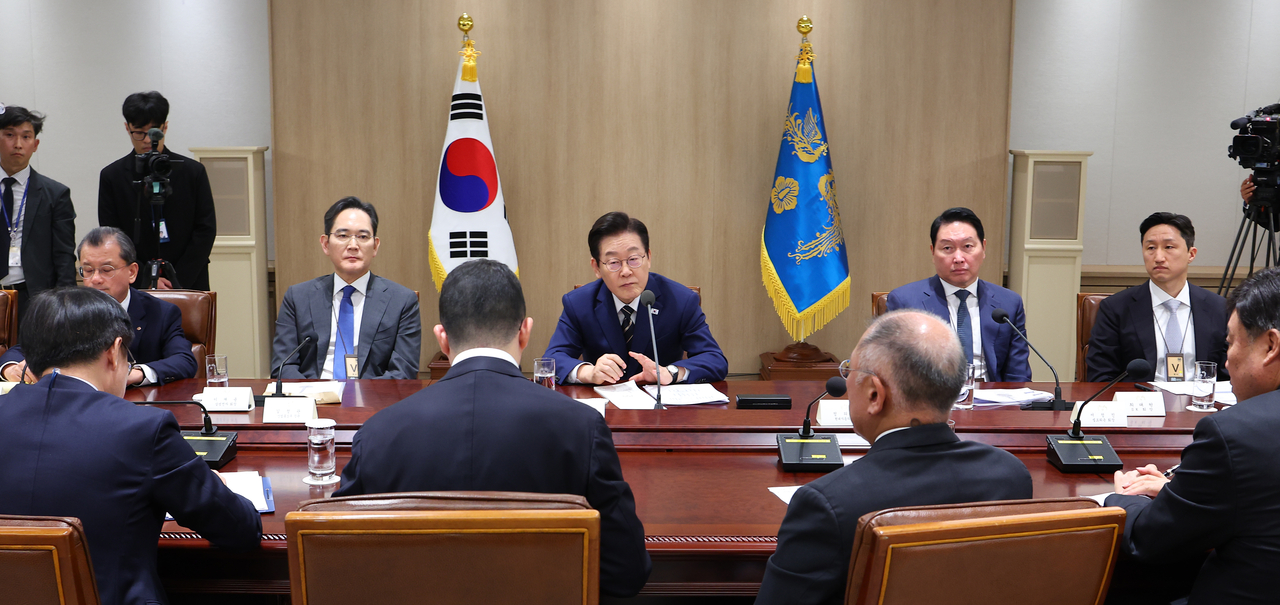
South Korean President Lee Jae Myung vowed to remove regulatory barriers to support business activities during a Sunday meeting with heads of the country’s top conglomerates, held to discuss follow-up measures to the recently closed tariff deal with the US.
Underscoring their joint efforts in successfully concluding the tariff negotiation, Lee also expressed appreciation for the dedication of corporate leaders.
“I will do my best to minimize the barriers for companies to do business. It is the role of the government to support conglomerates to work creatively on the global stage,” Lee said during the meeting.
"If you tell me the specific regulations that need to be eased or removed for better business activities, I will quickly address them."
The meeting brought together the heads of leading conglomerates, including Samsung Electronics Chairman Lee Jae-yong, SK Group Chairman Chey Tae-won, Hyundai Motor Group Chair Chung Euisun, LG Group Chairman Koo Kwang-mo, HD Hyundai Chair Chung Ki-sun, and Celltrion Group Chairman and founder Seo Jung-jin. Government officials playing key roles in the negotiations, including Industry Minister Kim Jung-kwan and National Security Adviser Wi Sung-lac, also joined in the meeting.
"Many officials worked hard, but the ones who contributed the most were the entrepreneurs here today," President Lee said. "I don't think there has ever been another case where the government and industry worked together this seamlessly."
South Korea and the US released on Friday the full details of their tariff agreement, under which Seoul agreed to a $350 billion investment in the US, and Washington agreed to reduce tariffs on key Korean goods, including cars, to 15 percent.
As the deal requires large-scale investments from Korean conglomerates, Lee acknowledged that Korea had limited room to make the final decision and urged the firms to work closely with the government to turn the situation into an opportunity.
Lee also asked companies to continue expanding domestic investment, addressing concerns that increased US investment might draw resources away from Korea.
On research and development and high-risk investment areas, the president suggested that the government is willing to adopt new financial tools to encourage bolder corporate investment.
"The government, for example, could purchase subordinate bonds issued for R&D, or take on first-loss risk,” he said. “I am ready to consider such measures for the companies to pursue their ambitious and high-risk investments."
Conglomerate leaders also welcomed the president's remarks and promised to expand domestic investment and hiring.
"Companies are greatly relieved with the agreement reached (between Korea and the US). Based on this, we will actively cooperate with the government to ensure that all follow-up measures proceed smoothly," Lee of Samsung said. Samsung is the country's largest conglomerate by revenue.
"Even though the conditions are tough and the economy is far from easy, we will hire 60,000 people in Korea over the next five years. We will also step up domestic facility investments, including R&D," he said.
The Samsung chief also promised to invest 450 trillion won over the next five years, with part of that going into building the fifth manufacturing plant at the Pyeongtaek Campus. Known as P5, the plant is planned for operation in 2028. The company also said it will build local production facilities for the FlaktGroup, Europe’s largest heating, ventilation and air conditioning company that it acquired in November, as well as for Samsung SDI, its battery affiliate in Ulsan.
SK's Chey, who also serves as the head of Korea Chamber of Commerce and Industry, said the group's investment is expected to expand beyond its previous promise of 128 trillion won ($88 billion) by 2028.
"Amid the growing demand for advanced memory chips and the need for better manufacturing facilities, our investment is increasing continuously. I expect our investment to reach some 600 trillion won in the coming years."
Chung of Hyundai Motor Group also underscored the conglomerate's commitment to invest 125 trillion won in Korea over the next five years, saying that the amount is an increase of 8.2 trillion won from its previous plan.
LG's Koo promised to spend 60 percent of the group's planned investment — 100 trillion won over the next five years — on developing materials, parts and equipment technologies, and to work closely with smaller industry partners.
herim@heraldcorp.com