US study plans clouded by threats of stricter visa policies, social media screenings
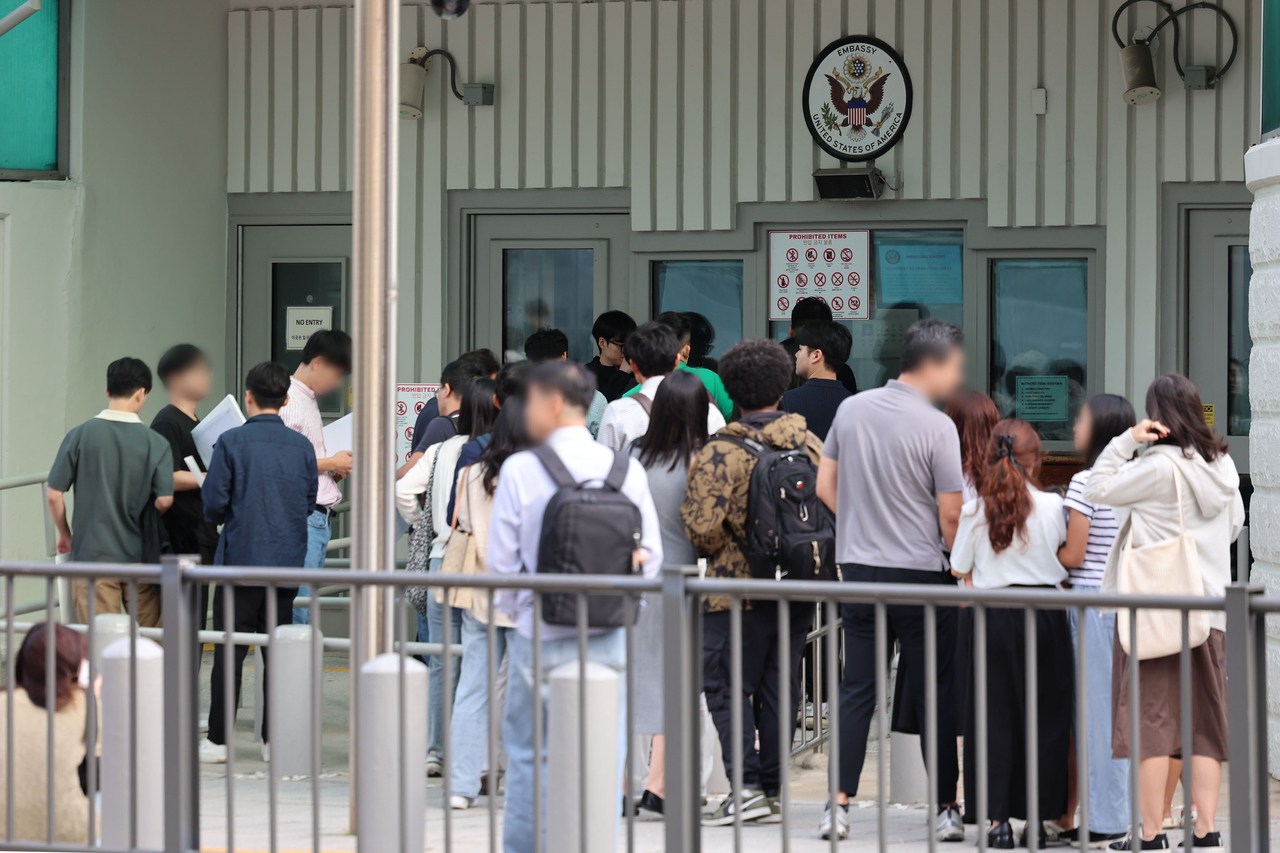
When 24-year-old Kim Yeon-joo, not her real name, opens her laptop each morning to resume drafting her personal statement, the first website she checks is no longer her dream university’s admissions page. Instead, she scrolls through the news.
For many Korean students hoping to pursue higher education in the United States, a path once seen as competitive but predictable has become increasingly uncertain.
Under US President Donald Trump’s renewed push to tighten immigration controls, prospective applicants say they feel the pressure more acutely than ever.
Kim, who intends to study for a Juris Doctor degree, described the deteriorating visa environment as something she never expected. When the Trump administration introduced a proposal that would charge a $100,000 fee for H-1B visa petitions, she said she began to question whether she could commit her future to the US.
“It really made me second guess whether all the effort was really worth it,” she said. “From past events it doesn’t seem likely that tightening immigration will be reversed even if the Democrats win. I think it’s pretty apparent that if you wish to study in the US, it is better to do it as quickly as possible than wait and hope for the next administration to reverse it.”
Since Kim began preparing her application, a series of policy announcements have shaken international student communities. In May, the administration instructed US embassies to temporarily pause screening interviews for student and exchange visitor visas.
The following month, it expanded the scope of social media vetting. Officials also threatened to limit student visa validity to four years regardless of program length and raised the possibility of scaling back the Optional Practical Training program, which allows foreign graduates to remain temporarily in the US for work experience.
In September, the H-1B visa and ESTA processing fees have been increased to $100,000 and $40, respectively.
This month, US media reported about a separate directive from Secretary of State Marco Rubioto to consider obesity, diabetes, cancer and other health conditions as grounds for denying visas.
Students like Kim have started making adjustments both online and offline.
“I have heard horror stories about US Immigration faulting anything on your social media, so I tried not to like any content for about two months. Now I try not to follow any accounts that might be in opposition to the ruling party or post anything political,” said Kim.
Another 24-year-old applicant surnamed Kim, who currently works for an international organization, said she had always assumed she would pursue graduate school in the US after attending recruiting fairs.
Universities even promised full funding and stipends. But the latest visa rules made her reconsider. She has now added schools in the United Kingdom to her list.
Others echo similar anxiety. A student surnamed Yoon, who recently completed a semester abroad on an F-1 visa, said the atmosphere shifted noticeably after US immigration authorities detained Korean engineers at a Hyundai plant in Georgia.
“Even though I did nothing wrong, I was worried I may have crossed them somehow,” he said. “People around me were also worried about what could happen next.”
Fear has prompted resource-sharing among peers. An anonymous KakaoTalk chat room dedicated to Koreans navigating the US visa process was created on Oct. 3, quickly filling with stories of rejections and scrutiny.
Messages alleged interview failures, Instagram checks and abrupt appointment cancellations. Panic rose again in early November when users reported a sudden halt in visa processing.
However, not all prospective students see cause for alarm. Moon Young-joon, not his real name, who began a graduate program in the US this fall, said he remained largely unshaken.
“Almost a week after I received my visa, they stopped taking visa appointments at the (US) embassy (in Seoul) and some students who were delaying making their final decisions were affected,” said Moon. “I was pretty lucky.”
He acknowledged a sense of unease when news broke that a Korean green card-holder enrolled at Columbia University had been detained by immigration officers. Still, he believes such incidents are not reflective of the average experience.
“(My friends) neither felt like they needed to censor themselves or that they were being watched or threatened with deportation,” Moon said. “That made me feel better. I did not want to uproot my entire life trajectory based on assumptions or the media’s worst-case scenarios.”
A student surnamed Lee, who plans to enroll next year, expressed a similar view. “The university promised to help with my visa,” he said. “If you’re moving to a new place, you have to take some risks.”
Despite differing levels of concern, all students pointed to the same underlying challenge: increasing uncertainty. Trump’s renewed rhetoric has centered on heightened visa screening, expanded enforcement against overstays, and more control over universities -- proposals that remain in flux. For Korean students, whose education plans often span years, the lack of clarity alone is enough to trigger anxiety.
Kim Yeon-joo said she has long understood that life in the United States would come with difficulties.
“Some part of me always knew I would be unwelcome and unsafe in the US,” she said. “I’ve seen what it means to live as a minority through relatives who are Asian Americans — how you never fully belong and have less political and social power.”
She once held firm belief in America’s promise of equality before the law and trust in clear legal procedures. Those were principles she said gave the country strength even through political strain. But recent events have complicated that view.
“The immigration climate has tested my faith,” she said. “I am anxious and skeptical now. I still want to go to the US, but nothing feels guaranteed. I have to prepare for the very real possibility that I may return to Korea or work in a third country instead.”
seungku99@heraldcorp.com