GYEONGJU, North Gyeongsang Province — South Korea and China agreed Saturday to expand cooperation across trade, finance and emerging industries, marking a reset in bilateral ties strained by geopolitical tension and supply chain realignment.
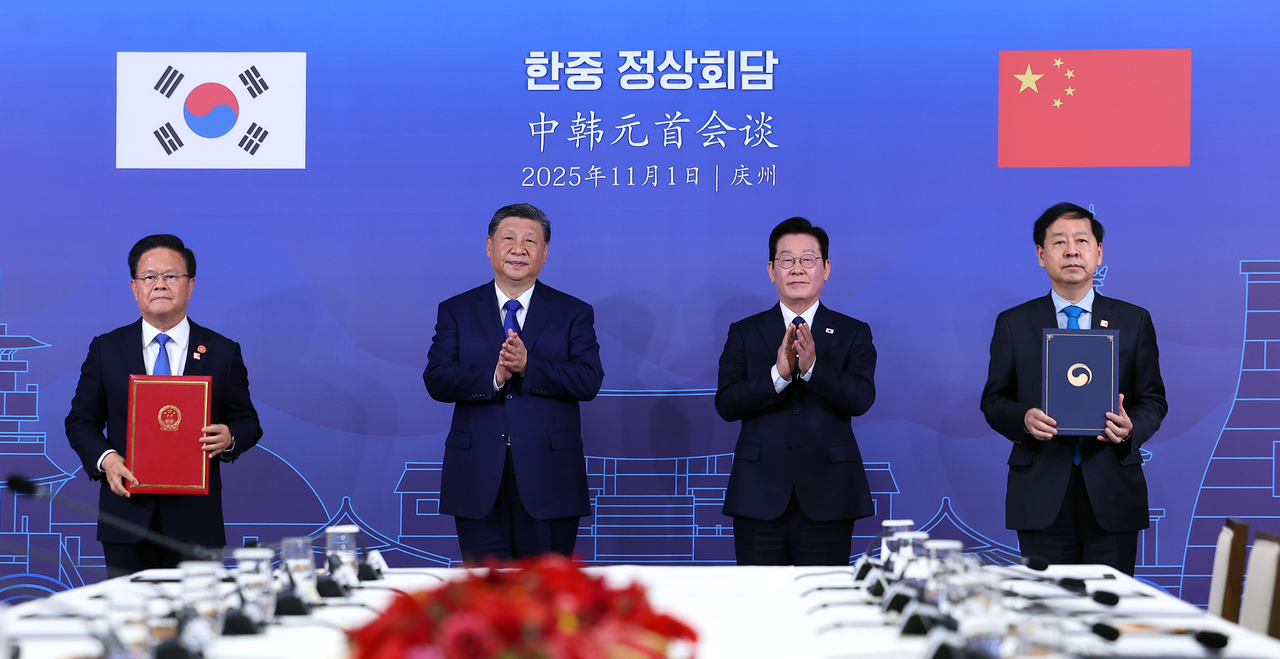
During a 95-minute summit at the Gyeongju National Museum, President Lee Jae Myung and Chinese President Xi Jinping witnessed the signing of seven memorandums of understanding, including the extension of a currency swap deal.
The Korean president said the two economies were moving from “a vertical division of labor” toward “a horizontal and mutually beneficial partnership,” adding that the evolving structure of supply chains called for a “new model of cooperation” suited to an era of industrial transformation.
According to China's Xinhua News, Xi said China is ready to work with South Korea on the basis of mutual benefit to fast-track "the second phase of their free trade agreement talks" and "expand cooperation in emerging sectors like artificial intelligence, biopharmaceuticals, green industries and the silver economy" in order to elevate the overall quality of bilateral economic and trade ties.
The second phase of the FTA aims to broaden the scope of the 2015 agreement, which mainly focused on the reduction of tariffs on industrial goods, to cover new areas such as services, investment and digital trade.
National security adviser Wi Sung-lac said in a briefing that the two leaders agreed to "pursue tangible outcomes in livelihood-related sectors that people can feel in their daily lives."
Key agreements included a won-yuan currency swap renewal between the Bank of Korea and the People’s Bank of China — part of what Seoul described as efforts to “translate the leaders’ shared vision for practical, people-centered cooperation into concrete outcomes.”
According to the presidential office, the won-yuan currency swap carries a five-year term and a value of 70 trillion won ($49 billion).
"It is expected to contribute to the stability of the two countries’ financial and foreign exchange markets and help promote trade," it said in a statement.
The presidential office added that the two sides also exchanged documents on six additional agreements aimed at setting a long-term direction for cooperation.
These include the 2026-2030 Joint Economic Cooperation Plan and an MOU on strengthening services trade, which together represent a long-term blueprint for advancing mutually beneficial growth and modernizing the structure of bilateral trade and investment.
Wi said the two leaders also pledged to diversify local-level consultation channels to boost regional economies, strengthen cooperation to stabilize supply chains and enhance collaboration in cultural and environmental fields to improve quality of life.
The two governments further agreed to simplify mutual travel procedures to promote people-to-people exchanges.
Agreements were also signed to promote cooperation in the "silver economy" — economic activity concerning the over-50s — and startup innovation, facilitate the export of Korean agricultural products to China, and strengthen joint responses to voice phishing and online fraud.
“These agreements set a long-term direction for advancing mutually beneficial cooperation and establishing a stronger institutional foundation for trade and investment,” the office said.
Wi also noted that Hanwha Ocean, the Korean shipbuilder recently targeted by Chinese sanctions, was part of the discussion.
“There was a productive exchange concerning Hanwha Ocean,” he said, responding to a question at the International Media Center in Gyeongju.
“As the issue is linked to broader US-China trade tensions, we expect that if the atmosphere improves between Washington and Beijing, there could be positive progress for Hanwha Ocean as well.”
Last month, Beijing unexpectedly imposed restrictions on five US subsidiaries of Hanwha Ocean, a key partner in the “Make American Shipbuilding Great Again” project, which involves Korean firms building vessels in the US.
China remains Korea’s largest trading partner, accounting for roughly one-fifth of total exports.
Yet bilateral trade has slowed in recent years amid weakening demand and technology restrictions driven by global geopolitical shifts.
Xi’s visit, his first state trip to Korea in 11 years, came as both nations seek to reposition themselves amid shifting global production networks.
hnpark@heraldcorp.com