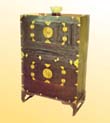
1. Black paulownia nong |
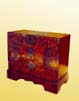
2. Linden bandaji |
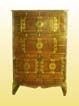
3. Zelkova jang |
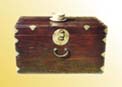
4. Paulownia ham |
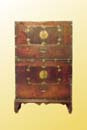
5. Red paulownia nong |
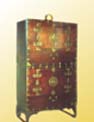
6. Wild walnut nong |
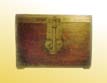
7. Red pine ham |

8. Cherry bandaji |
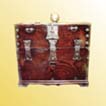
9. Zelkova bandaji |

10. Persimmon nong |
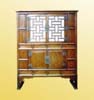
11. Zelkova lattice jang |
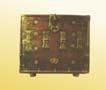
12. Pine framed bandaji |
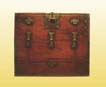
13..Red pine bandaji |
|
In these pages you will
find a photo sampling of Korean chests from the last full century of
the Chosun dynasty (1392-1910). We hope these photos show the basic
character of this genre of Korean art, which is characteristic of much
other Korean art: "created by nature with borrowed human hands."(1)
The goal of the Chosun chest maker was to celebrate the wood’s lines,
hues, tones and texture in his product. This focus on nature gives the
Chosun chest a dignified yet non-assertive personality that makes it
comfortable in any home, traditional or modern, in Asia or in the West.
In addition to displaying
a deep regard for nature, chests made for aristocracy embodied an additional
feature: Korean neo-Confucian philosophy. Chests with sombre hue and
subtle grain symbolized the sobriety expected in the deportment of the
Confucian gentleman and were used in his realm in the home; the more
decorative woods were used in the chests kept in the women's domain.
Fittings were more prolific and more decorative on chests used by women
than on chests used by men.
The chests presented here
are the bandaji, jang, ham, and nong. (For
information on the pronunciation of Korean, see the box "Romanization,"
below.) The bandaji was used for storing clothing, documents and valuables
inside, and bedding on top during the day (which explains why it is
called a "blanket chest" in English). It has one door, which usually
runs the entire width of the chest and opens down from the very top.
The jang has from one to three levels (rarely a fourth) in one frame,
with two outward-opening doors in the center of each level. The ham
was a box for items of special significance. The nong was basically
a box, usually stacked with another exactly the same and set on a base
but occasionally placed separately.
Every genre of art in
every culture has levels of sophistication, ranging from "representative"
- the most sophisticated works, which the people of the culture like
to think represent that genre in their culture - to kitsch. "Representative"
Chosun dynasty chests are those that were crafted before the end of
the nineteenth century, when society was a pyramid of royal family,
aristocracy, commoners, and low-born. The royal family and aristocracy
included only ten to fifteen percent of the population; most chests
were crafted for the royal family and aristocracy, in the commissioner's
establishment by one craftsman. Because the upper class comprised such
a small part of the population, relatively few chests were made, and
most of these chests have been lost to ordinary wear, invasions, and
expatriation; almost none exist from before the nineteenth century.
After 1890, with the country's
change from an agricultural to an industrial and commercial society,
its social hierarchy also changed. More people had money, and distinctions
between the different classes weakened; at the same time, the place
of craftsmanship changed from the commissioner's location to the shop
or factory. And with this ended the crafting of the Chosun chest as
an invidual piece of art.
It has been estimated
that as of today approximately only about five percent of the "antique"
chests being sold these days on the open market are completely authentic
Chosun dynasty chests. (Some of the ornamental fittings and hinges on
these authentic chests, though not original with the piece, are often
antiques in themselves because they were made long, long ago.) The vast
majority of pieces that we find on the market now is early twentieth-century
shop or factory production, lightly or heavily restored Chosun dynasty
chests (with new parts or parts cannibalized from other old chests),
and reproductions. The small number of authentic Chosun chests available
on the market is decreasing even more by the year, and they are becoming
more and more valuable.
Unfortunately, over the
years the colors in some of the photos have corrupted. I can't fix them
because I don't have the original photos.
Click on one of the
thumbnail photos to the left to get a close-up look and detailed information
about that chest. To get information on the photographing of these chests,
determining age and authenticity, and sources of information on Korean
chests, click here.
| Romanization: Korean
vowels are romanized here according to Latin pronunciation (so
that u, for example, is pronounced oo as in food), with two exceptions:
for the vowel that sounds something like the u in nut, I use o
(that's an o underlined), and for the vowel that sounds something
like the oo in good, I use u. An
apostrophe either separates two syllables (Kyong-gi is
Kyong'gi) in a potentially confusing combination of consonants,
or marks an aspirated consonant (e.g., in ch'ung, the ch is pronounced
something like the ch in church). |
-
- (1) Edward Wright, Man
Sil Pai. 1984. Korean Furniture: Elegance and Tradition. Tokyo:
Kodansha International.
I am far from expert on Korean chests. However, if you have a
comment or a question, e-mail me at jfholstein@yahoo.com.
|
 mojo@edunet.kmec.net