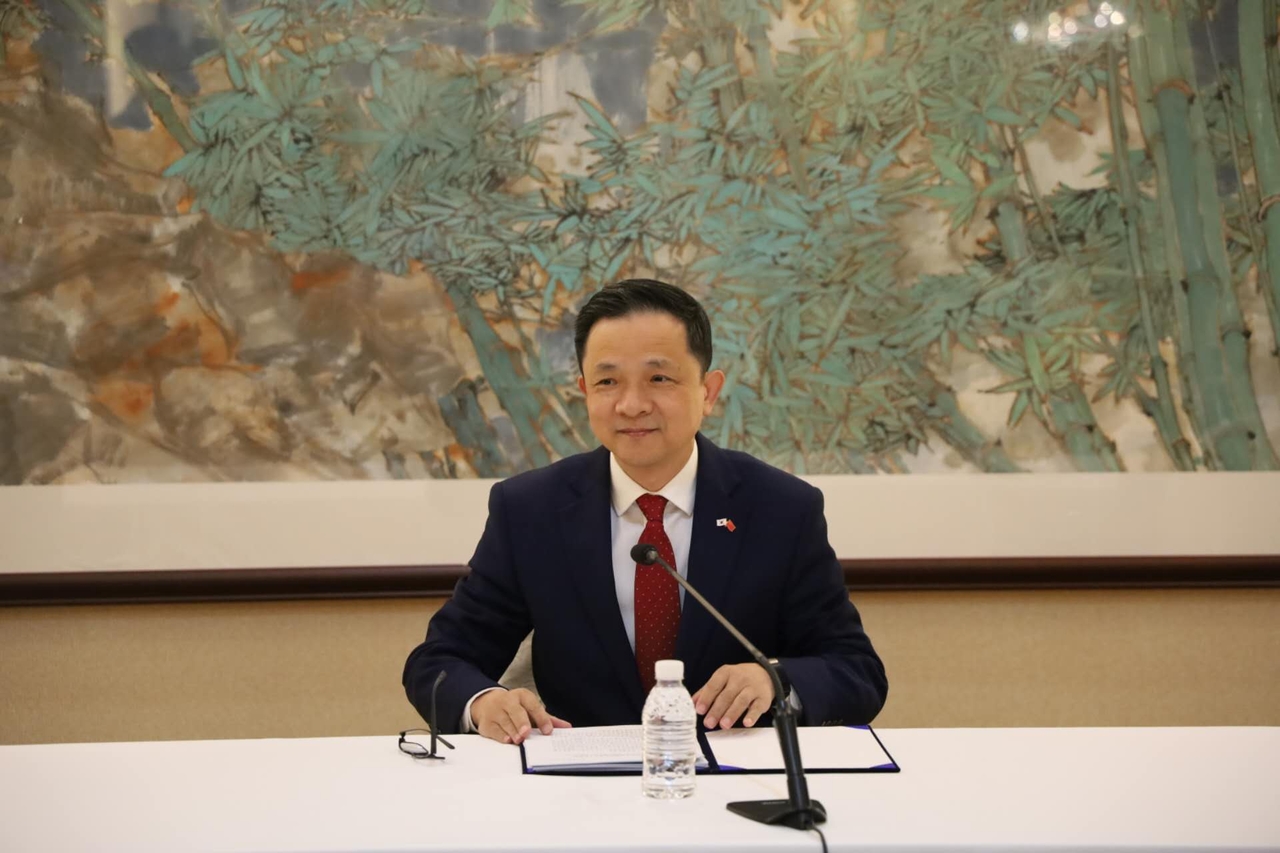
The Chinese envoy to South Korea urged Seoul to proceed “prudently” with its plan to develop nuclear-powered attack submarines in coordination with the United States.
Ambassador Dai Bing further warned that the South Korea–US alliance’s push for “modernization” could prompt a shift in Beijing’s posture if it expands into new strategic objectives beyond the Korean Peninsula.
Dai reiterated the Chinese Foreign Ministry’s concerns about cooperation between Seoul and Washington on the submarine-building project during a press briefing Thursday at the Chinese Embassy in Seoul.
Dai explained that "China and South Korea have maintained communication through diplomatic channels, and China has expressed its concerns."
"South Korea-US cooperation on nuclear-powered submarines is not a purely commercial matter; it concerns the international nonproliferation regime as well as stability on the Korean Peninsula and in the broader region," Dai told South Korean and Chinese media outlets.
"We therefore hope the South Korean side fully considers the concerns of all parties and handles the issue prudently," he added.
Seoul and Washington have agreed to work together to enable South Korea to build nuclear-powered attack submarines with US approval and support to secure the necessary nuclear fuel, according to a joint fact sheet on trade and security agreements issued by the two countries on Friday.
The Chinese Foreign Ministry expressed Beijing’s hope that South Korea and the United States “will earnestly fulfill their nuclear non-proliferation obligations, and do what is conducive to regional peace and stability, not otherwise,” on Oct. 30.
The response came a day after President Lee Jae Myung asked US President Donald Trump to give the green light to building nuclear-powered submarines to bolster South Korea's independent defense capabilities during the Gyeongju summit.
Seoul’s position is that the "submarine it seeks to develop and operate is a conventionally armed, nuclear-powered submarine, and that this is in full compliance with the Nuclear Non-Proliferation Treaty."
China warns Seoul not to ‘play with fire’ on Taiwan
Speaking at the news briefing, Dai also underscored China’s concerns about the ultimate purpose of the alliance’s “modernization,” asking whether it refers merely to upgrading certain facilities or to a broader adjustment of strategic objectives.
“First, South Korea and the United States are in an alliance relationship; this was formed by history, and we express respect,” Dai responded to the question on how the modernization of the alliance might influence regional security dynamics and the role of US Forces Korea in South Korea-China relations.
“If the strategic objectives of the South Korea–US alliance change, then China’s view of the alliance will also change,” he added.
Dai also noted that “South Korea and the US do not share the same views” on the alliance modernization.
However, Dai drew a clear red line when asked about China’s position on a potential readjustment of the role of US Forces Korea, including the scenario that the troops could be drawn into a Taiwan Strait contingency.
“If the South Korea–US alliance were to show new moves related to Taiwan, China would have serious concerns,” Bing said.
“I also hope that the South Korea-US alliance absolutely will not play with fire on the so-called Taiwan issue,” he added.
Dai reiterated China’s long-standing position on Taiwan, noting that every country establishing diplomatic relations with China — including South Korea — affirms in the documents establishing diplomatic relations that there is only one China and that Taiwan is part of China.
When asked about China’s view of the alliance’s Make American Shipbuilding Great Again, or MASGA, initiative, Dai dismissed it as a US attempt to impede the development of China’s shipbuilding industry.
“Attacking China’s shipbuilding industry is merely one of the tools the United States uses against China,” Dai said.
Against that backdrop, Dai further defended China’s imposition of sanctions on five US-linked subsidiaries of South Korea’s Hanwha Ocean in October, before Beijing announced a one-year suspension Monday.
“This is not aimed at the South Korean government, but is part of China’s countermeasures against the US for its Section 301 Investigations and other actions against China,” Dai said.
“Of course, this issue should draw high attention from the South Korean side and lessons should be learned from it. China cannot possibly ignore any actions that harm China’s interests," he added.
dagyumji@heraldcorp.com