As the extended reality (XR) industry accelerates globally, competition is heating up among South Korea, Japan and China over next-generation display technologies -- particularly OLED-on-Silicon (OLEDoS) panels, a key component for ultra-high-resolution headsets.
Japan currently dominates the OLEDoS market, with Sony leading the global supply. However, China is rapidly scaling up production through aggressive state-backed investments. Now, Korea's Samsung Display is making a major move, beginning mass production of its own OLEDoS panels -- signaling a shift in the regional tech race.
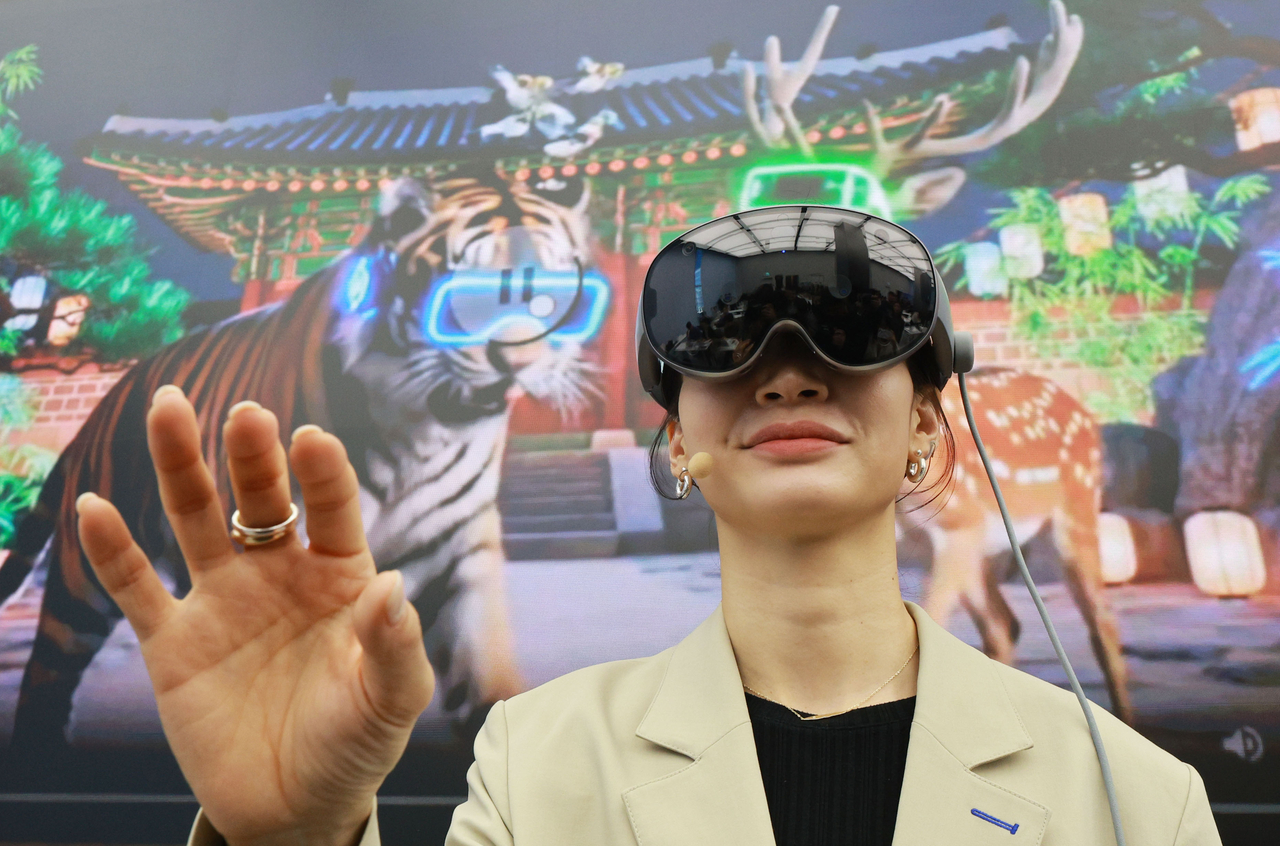
According to industry sources on Friday, Samsung Display has commenced volume production of 1.3-inch, 4K-class OLEDoS panels to be used in Samsung Electronics’ new Galaxy XR headset, unveiled last month. This marks Samsung Display’s first foray into commercial-scale manufacturing of the microdisplay technology, widely regarded as a successor to conventional OLED displays.
Previously, Sony had served as the primary supplier of OLEDoS panels for Samsung’s XR devices. With Samsung Display now ramping up its own production, its panels are expected to replace or complement Sony’s components in future product iterations.
OLEDoS is a microdisplay technology that involves directly depositing OLED materials onto silicon wafers, instead of traditional glass substrates. This structure enables the integration of ultra-fine circuitry, allowing for exceptionally high pixel density — making it particularly suitable for XR and virtual reality headsets, where displays are positioned close to the user's eyes.
Sony continues to hold a dominant position in the market, with a share exceeding 70 percent and an annual output capacity of around 900,000 units. The Japanese tech giant was also the exclusive panel supplier for Apple’s first-generation Vision Pro headset, launched last year.
However, Chinese display makers are closing in. Seeya has already provided Full HD-grade OLEDoS displays for DJI’s Goggles 2 headset, while both Seeya and BMOT, a BOE subsidiary, are expected to begin panel supplies for Meta’s Quest lineup as early as next year. Additional players like Sidtek are expanding into 12-inch production lines, triggering a wave of capacity-driven competition.
Samsung Display, meanwhile, is not only targeting internal demand from Samsung Electronics but is also positioning itself as a potential supplier for Apple. The Korean panel maker established a dedicated OLEDoS business unit last year following its $218 million acquisition of US-based RGB OLEDoS pioneer eMagin.
In August, Samsung unveiled a prototype OLEDoS panel boasting 5,000 PPI and peak brightness of 20,000 nits -- equivalent to the luminance of 20,000 candles. The RGB OLEDoS architecture, which directly deposits red, green and blue subpixels onto silicon wafers, remains in the early stages of commercialization but is seen as a promising leap for ultra-high-resolution microdisplays.
LG Display, another Korean panel maker, is also stepping up its research and development efforts. The company introduced a 1.3-inch OLEDoS prototype for smartwatches last year and unveiled additional display concepts tailored for VR applications.
While Apple’s Vision Pro has faced mixed market reactions -- due to its high price, limited content offerings and usability concerns -- industry watchers believe broader adoption of XR devices could bring down OLEDoS costs, spurring mass-market penetration.
“As the XR ecosystem expands, competition surrounding OLEDoS panels will intensify,” said an industry source who requested anonymity. “While Japan may maintain its lead for now, the balance of power could begin to shift around 2027 or 2028 as Korean and Chinese companies scale up.”
Market research firm Omdia forecasts the global XR display panel market will grow from $600 million this year to $4.1 billion by 2030, representing a compound annual growth rate of 47 percent. OLEDoS panels are expected to account for 70 to 80 percent of total XR display sales by the end of the decade.
yeeun@heraldcorp.com