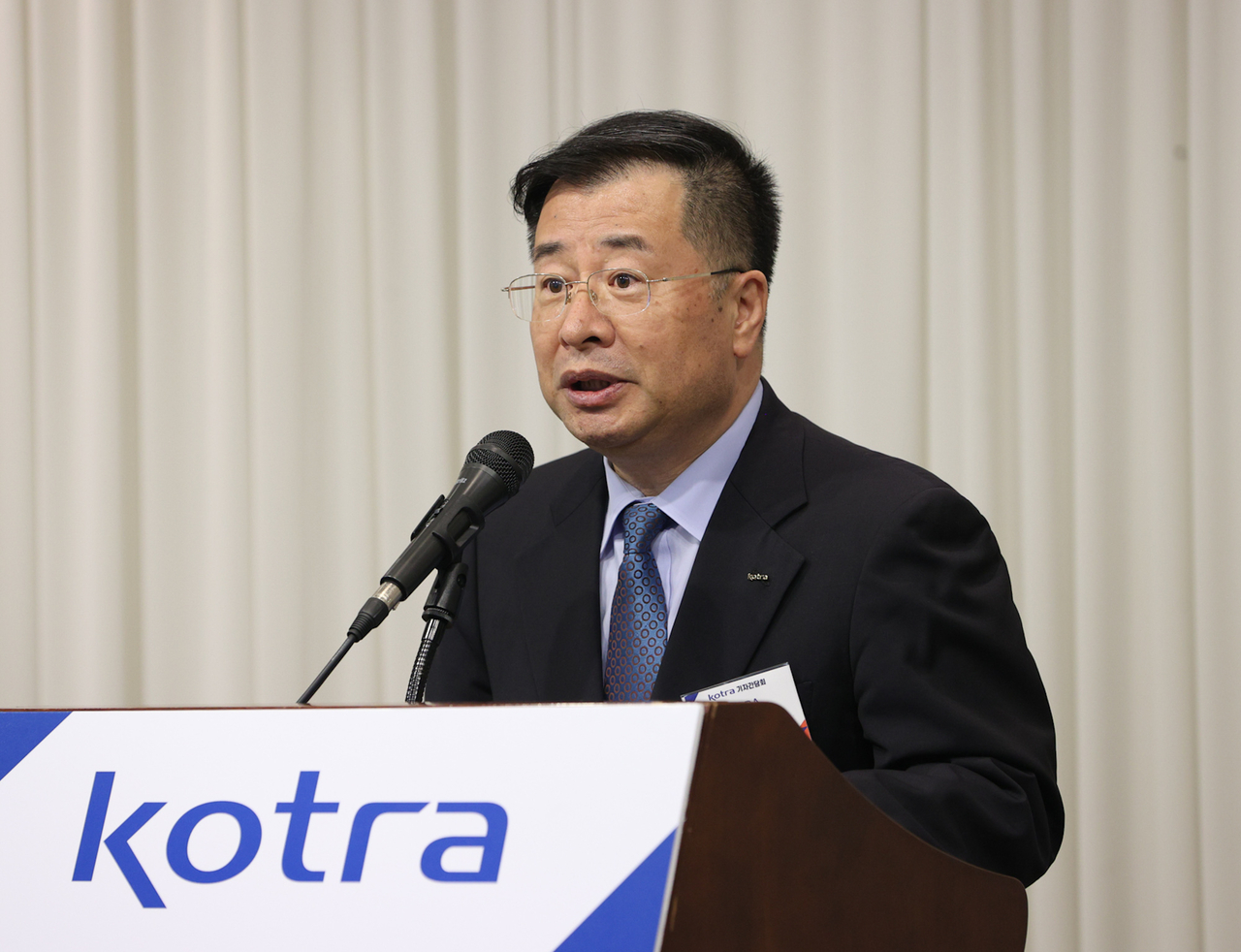
Fueled by the global rise of Hallyu and the rapid international expansion of Korean consumer goods, Kang Kyung-sung, president of the Korea Trade-Investment Promotion Agency, vowed to devote his organization's full efforts to diversifying exports and accelerating South Korea’s push toward annual exports of $1 trillion.
“As the power of Hallyu grows, exports of K-consumer goods have once again given South Korea a chance to seize the opportunity and achieve significant growth,” Kang said during a press briefing marking his first anniversary in office on Thursday in central Seoul.
Kang said the recent surge in Korean consumer goods is not a temporary spike but a sign that Korea has “finally won over global consumers," bringing a structural shift that diversifies the country’s export portfolio. Korean exports, long dominated by business-to-business heavyweights such as semiconductors, are now expanding into business-to-consumer categories such as beauty, food and fashion.
South Korea’s efforts to diversify its exports are already showing positive outcomes, Kang added. From January to October, the country’s exports reached $579.3 billion, up 2.4 percent on-year, achieving an all-time high for the period.
In this period, exports showed contrasting trends by region. Shipments to China and the US fell 3.8 percent and 5 percent, respectively, while exports to ASEAN rose 5 percent, the European Union 3.9 percent, Taiwan 50.8 percent, Latin America 3.9 percent, the CIS -- a bloc of post-Soviet economies such as Russia, Kazakhstan and Uzbekistan -- 20 percent and India 2.8 percent.
Exports of consumer goods, which include food, cosmetics, fashion and pharmaceuticals, climbed 6.6 percent in the January-September period compared to the previous year, marking an unprecedented high for those nine months, he said.
Through this diversification of export markets and product categories, Kang said he aims to help South Korea move beyond the $1 trillion milestone. He further committed to securing a spot among the world's five largest exporting countries. Presently ranked sixth globally behind China, the US, Germany, the Netherlands and Japan, South Korea trails Japan by a margin of just $23 billion, which Kang believes Korea can overtake in the near future.
“In a rapidly changing trade environment, the only way for Korea to remain an unwavering export powerhouse is to diversify export markets and export items.”
To that end, KOTRA plans to expand its presence and programs in the Global South, with a particular focus on ASEAN and India, he said.
Of KOTRA’s 131 overseas trade offices, about half, or 68, are located in the Global South, and most newly established offices are now being set up in these regions.
“Latin America and Africa were once considered difficult markets due to physical distance, but in consumer goods, such barriers no longer exist due to e-commerce platforms,” he said, noting many cosmetics and pharmaceutical firms are now visiting KOTRA’s trade offices in Latin America.
“I believe Latin America and Africa are not just future markets, but are becoming core markets,” said Kang. “There are opportunities in these regions.”
Kang pointed out that while tariff negotiations took center stage this year, the coming year will be marked by intensified competition over the reorganization of global supply chains.
“KOTRA will strengthen early monitoring and preemptive response systems for critical minerals, diversify import sources and support domestic production to stabilize supply chains,” he said.
He further stated that the agency will leverage its extensive overseas network to strengthen its role in addressing public safety issues affecting Koreans overseas, pointing to recent job scams in Cambodia and rising trade fraud cases.
sahn@heraldcorp.com