Exam maintains ban on 'killer questions,' as test committee vows fair, curriculum-based testing
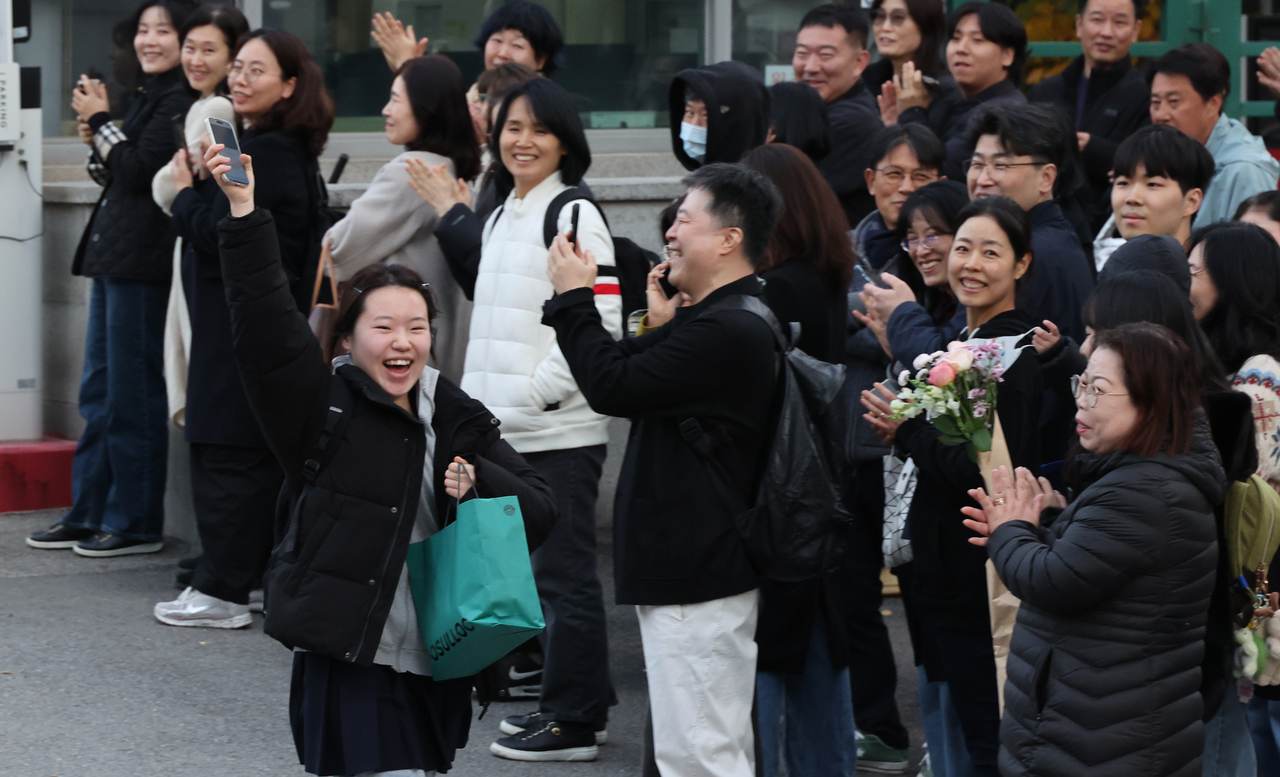
South Korea’s most consequential academic ritual ended Thursday, under unusually warm conditions, as more than half a million students sat for the College Scholastic Ability Test, or Suneung.
The 2026 Suneung marks the second year under the government’s policy of eliminating “killer questions,” referring to ultradifficult problems that go far beyond the high school curriculum and require university-level concepts to solve, with critics arguing that they deepen reliance on private tutoring.
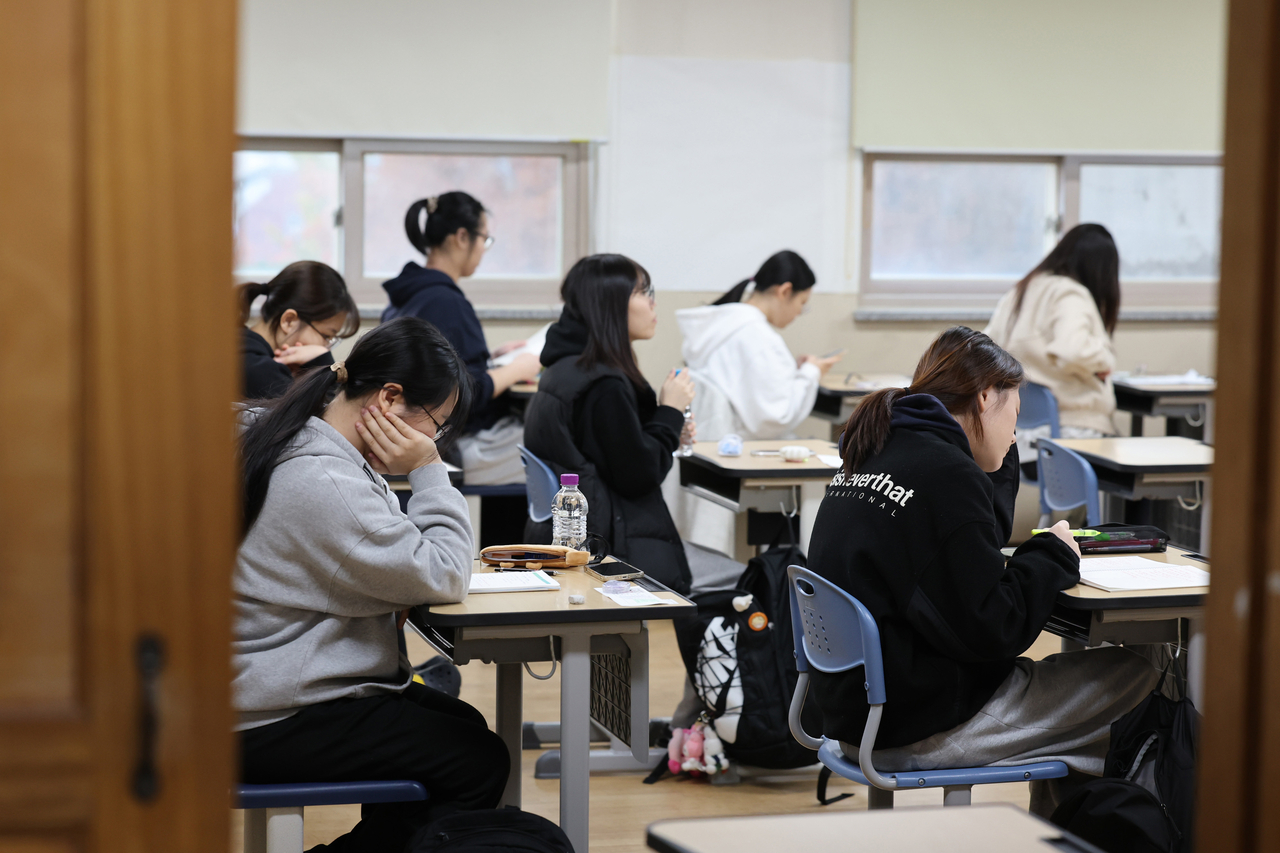
At a briefing in Sejong early Thursday, Kim Chang-won, head of this year’s Suneung question-setting committee, said the test was designed “at an appropriate level of difficulty,” free from items that favor private education or rely on repeated technical training.
“We excluded questions advantageous to students who learned test-taking tricks in private academies,” he said. “This year’s exam was developed to ensure sufficient differentiation solely through content taught in public education.”
Kim stressed that all sections were written in accordance with the 2015 revised high school curriculum. “We focused on core, fundamental content to help normalize high school education,” he said.
“Even if certain elements appeared in previous tests, we revised the format and approach to stay within curriculum boundaries while still evaluating students’ reasoning.”
The mathematics section was widely viewed as similar in overall difficulty to last year’s exam, though experts noted that several high-level questions appeared designed to sharpen differentiation among top-performing students.
Shim Joo-seok, an EBS mathematics instructor and teacher at Incheon Haneul High School, said at the government briefing in Sejong that the test “maintained its public-education-centered framework built on core concepts while strengthening separation among upper-rank groups.”
“Overall, the level of difficulty aligns closely with last year’s Suneung,” he added.
According to the committee, the Korean language section assessed students’ ability to interpret a wide range of texts and apply knowledge to unfamiliar materials, prioritizing creative and analytical reasoning.
The mathematics section avoided complex calculations or items solvable through rote formulas, instead emphasizing conceptual understanding and integrative problem-solving.
For English, which is graded on an absolute scale, questions used basic vocabulary drawn from the curriculum and high-frequency test words across listening, indirect speaking, reading and indirect writing.
Asked about the public fixation on top grades, Kim dismissed its relevance. “Under an absolute grading system, the percentage of students receiving Grade 1 is meaningless. Our focus is on accurately measuring language ability.”
Responding to concerns about the trend of natural-science students shifting en masse to the lighter social studies track, Kim said the phenomenon reflects a general instinct for students to choose the most beneficial option.
But he emphasized that the committee minimized any advantage or disadvantage stemming from subject choice. “If students studied conscientiously, any subject they selected should yield the results they hope for,” he said.
Kim added that last year’s widely praised difficulty level served as a benchmark. “We maintained last year’s approach so that standard score gaps would not differ significantly,” he explained.
The high-stakes exam has long been one of the nation's most defining moments for students, in large part determining university admissions, job prospects and, for many, the trajectory of their adult lives.
Temperatures on the big day were milder than the typical “Suneung cold wave,” and crowds of parents and teachers gathered early in front of test sites, offering hugs and final words of encouragement.
At many high schools, throngs of younger students lined the entrances in coordinated cheering squads, waving placards, chanting songs and forming human tunnels as the seniors made their way inside. Police managed traffic at major intersections nationwide to ensure test-takers could reach the sites without delay.
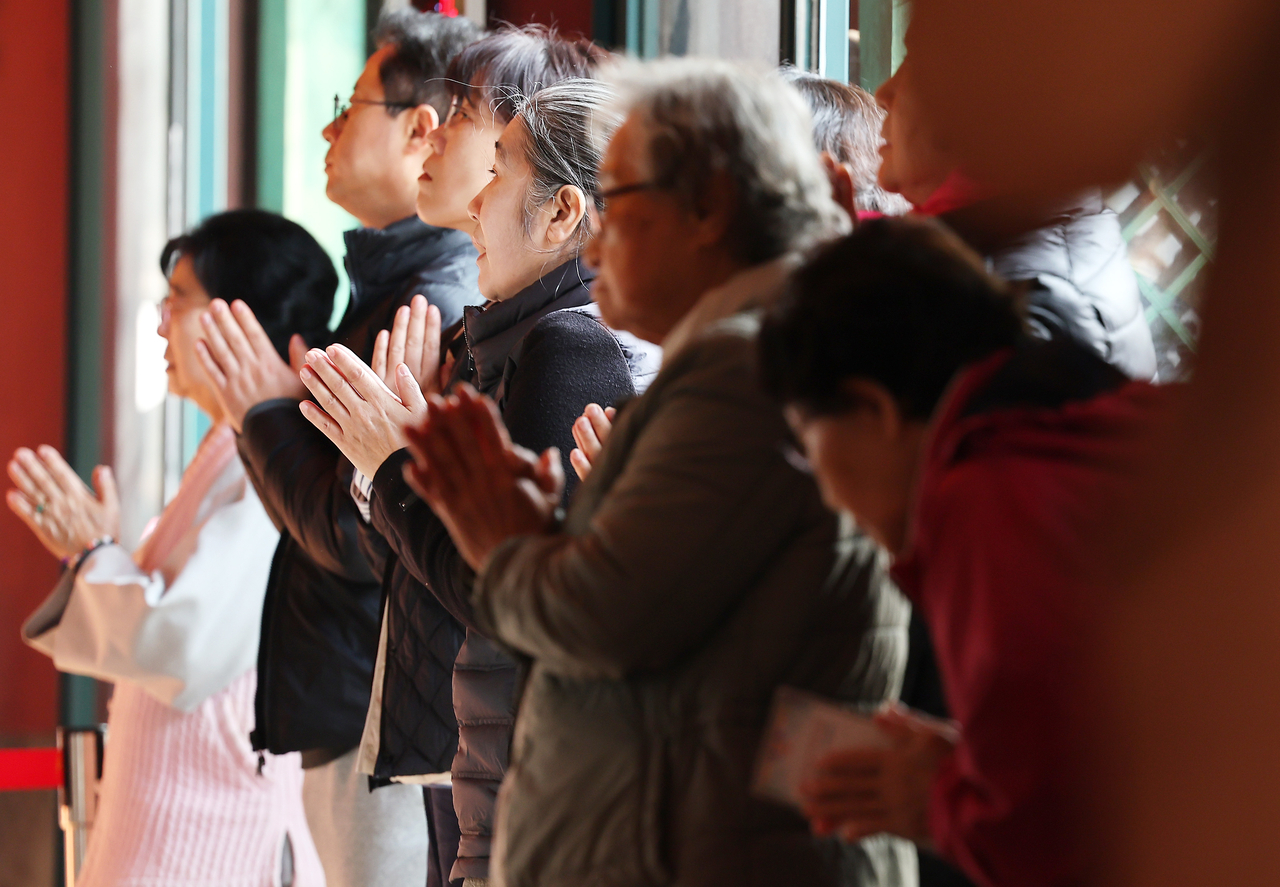
Temples and churches filled from dawn as families sought one final blessing for their children’s long-awaited day.
Upon the conclusion of Thursday’s exam, universities are to begin their rolling admissions review and early-decision interviews, followed by the release of official Suneung scores in December. Regular admissions schedules, including additional essays, practical exams and the nationwide application period, will proceed through early next year.
jychoi@heraldcorp.com