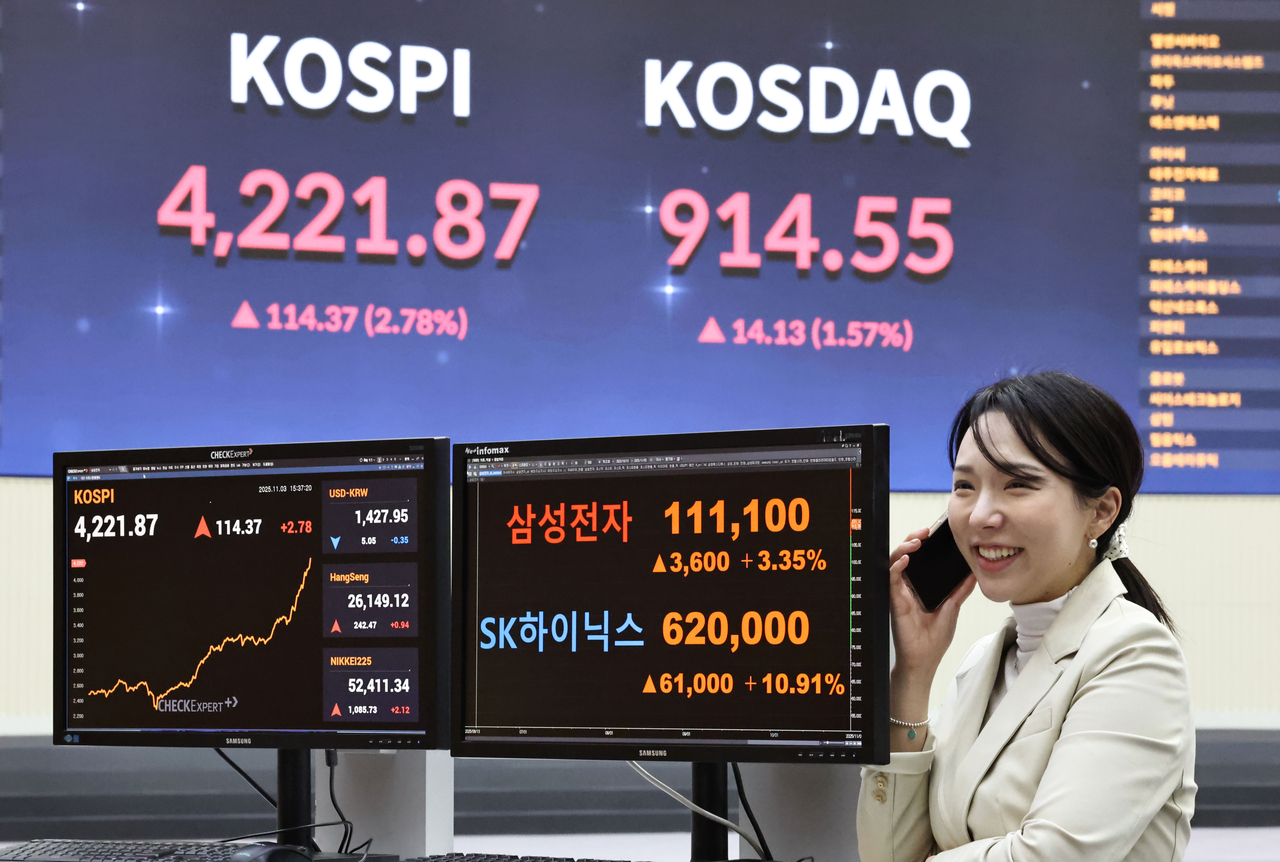
With Samsung Electronics shares now trading above 100,000 won ($68), investors are questioning whether the tech behemoth can sustain its upward trajectory to hit the 150,000 won level that several brokerages now predict, citing accelerating demand for the high-bandwidth memory chips critical for artificial intelligence.
Local brokerages rushed to lift targets after Samsung posted stronger-than-expected third-quarter earnings on Oct. 30 and AI giant Nvidia unveiled plans to provide GPUs to Samsung and other Korean tech companies the following day.
Korea Investment & Securities, KB Securities and Eugene Investment & Securities all raised their target prices to 150,000 won, while NH Investment set 145,000 won and Mirae Asset projected 142,000 won. SK Securities went further, calling for 170,000 won.
Even Morgan Stanley, which warned last year that “winter looms” for the memory chip sector, raised its Samsung target to 144,000 won and said its shares could even reach 175,000 won in a bull scenario, assuming robust demand for memory and organic light-emitting diodes continues, as macroeconomic conditions stabilize and China struggles to enter the memory chip industry.
HBM4 as the next big thing
The bullish outlooks are largely based on expectations that Samsung will be able to supply its next generation HBM4 chips to Nvidia and regain ground, following HBM3E delays that left the company trailing rivals, weighing down its earnings.
Kim Dong-won, a senior analyst at KB Securities, on Thursday said he expects Samsung to capture as much as 40 percent of Nvidia’s HBM4 supply chain next year, and forecast that Samsung’s HBM shipments will surge 2.5 times in 2026 compared with this year.
“Samsung is expected to benefit the most, as the discount applied to HBM over the past three years shifts to a premium, while prices for conventional DRAM continue to rise,” Kim said, noting the combination could push the company’s market value to 1,000 trillion won. Samsung’s market value as of Thursday press time stands at 675 trillion won.
Chae Min-sook, an analyst at Korea Investment & Securities, echoed the upbeat sentiment, saying “The AI-driven memory upcycle has only just begun."
“Average selling prices will keep rising through 2026 amid supply shortages, while expanded HBM sales will significantly boost profitability (for Samsung).”
Record profits expected in 2026
Samsung’s chipmaking device solutions division could post 61.8 trillion won in operating profit in 2026, representing a threefold increase from this year’s level, according to KB Securities. This growth would help push Samsung’s total operating profit to a record high of 82.2 trillion won.
For the fourth quarter of this year, KB forecast operating profit of 16 trillion won, up 147 percent on-year, which would mark the best quarterly performance since 2021.
Other houses also anticipate strong results in the October-December period. Eugene Investment & Securities expects operating profit to reach 15 trillion won in the fourth quarter, while Kyobo Securities has predicted 15.5 trillion won.
Boosted by the recent stock rally, Samsung Electronics' market cap exceeded 20 percent on the main Kospi index. According to the Korea Financial Investment Association on Thursday, Samsung’s common shares accounted for 18.33 percent of the Kospi’s market cap in November, while preferred shares added 1.98 percent, lifting the total weight to 20.31 percent.
It marked the first time in 13 months that Samsung returned to the 20 percent range, after its market cap sank to a nine-year low of 16.17 percent earlier this year during the semiconductor downturn.
Still, the stock's sharp rise has prompted caution over a possible correction. Last week, Samsung shares tumbled 5.6 percent just a day after hitting an all-time high of 111,000 won, as growing concerns of an "AI bubble" weighed on sentiment. The abrupt pullback further unsettled investors already on edge over heightened volatility in the global tech sector.
Shares of Samsung Electronics closed at 102,800 won Thursday, down 0.29 percent.
sahn@heraldcorp.com