Government, ruling party agree on 25% top rate, as Korea plans separate dividend tax to boost market
The government appears to be cementing its stance on dividend taxation, setting the top rate at 25 percent, lower than the initially proposed 35 percent that sparked investor backlash.
On Sunday, the government and ruling party agreed on the need to encourage dividend payouts to help boost the local stock market, signaling that a long-debated tax reform may be nearing its conclusion.
Still, the controversy is far from settled, with questions remaining over whether the lower top rate will truly benefit ordinary investors.
What’s changing
In July, the Finance Ministry proposed separating dividend taxation from other stock income in next year’s tax reform to encourage dividend growth and support the market.
Currently, dividend payouts are taxed under the comprehensive income system at a top marginal rate of 45 percent when total annual financial income exceeds 20 million won ($13,600).
Under the proposed system, dividend income would be taxed separately — 14 percent for under 20 million won, 20 percent for up to 300 million won and 35 percent for amounts beyond that. The latest government–ruling party deal suggests lowering the top rate to 25 percent.
The new regime would apply to "high-dividend" companies, which have raised payouts from the previous year and either maintain an annual payout ratio of at least 40 percent or exceed 25 percent with an average annual increase of at least 5 percent over the past three years.
The dilemma: Who really benefits
Critics question whether the change will benefit ordinary investors. Data from Democratic Party of Korea Rep. Ahn Do-geol shows that in 2022, the top 1 percent of dividend earners received 70 percent of all payouts, averaging 119 million won per person. The remaining 99 percent averaged just 510,000 won each, falling to about 150,000 won on average for the bottom 90 percent.
“Separate taxation itself is already a tax benefit. Lowering the rate on top of that effectively gives a double benefit,” said Woo Suk-jin, an economics professor at Myongji University.
Woo doubted the measure would lift Korean stock valuations, saying it gives little incentive for companies to expand payouts under the current governance structure.
“For controlling shareholders, it’s more profitable to retain earnings within the company,” he said. “Dividends cut into returns, and investors still pay tax. Only existing dividend holders benefit, with no real change other than reduced taxes.”
Finance Minister Koo Yun-cheol anticipated that lowering the top rate from 35 percent to 25 percent would reduce tax revenue by about 180 billion won. “The government is effectively spending a few hundred billion won just to calm the market,” Woo said.
Reform or relief?
Analysts say a shift toward pro-dividend policies is inevitable if Korea hopes to overcome its chronic “Korea Discount.” The country’s average payout ratio hovers around 28 percent, far below the US at 42 percent, Taiwan at 55 percent and Japan at 36 percent.
NH Investment & Securities estimates that raising it to 35 percent could help push the Kospi toward the government’s 5,000-point target.
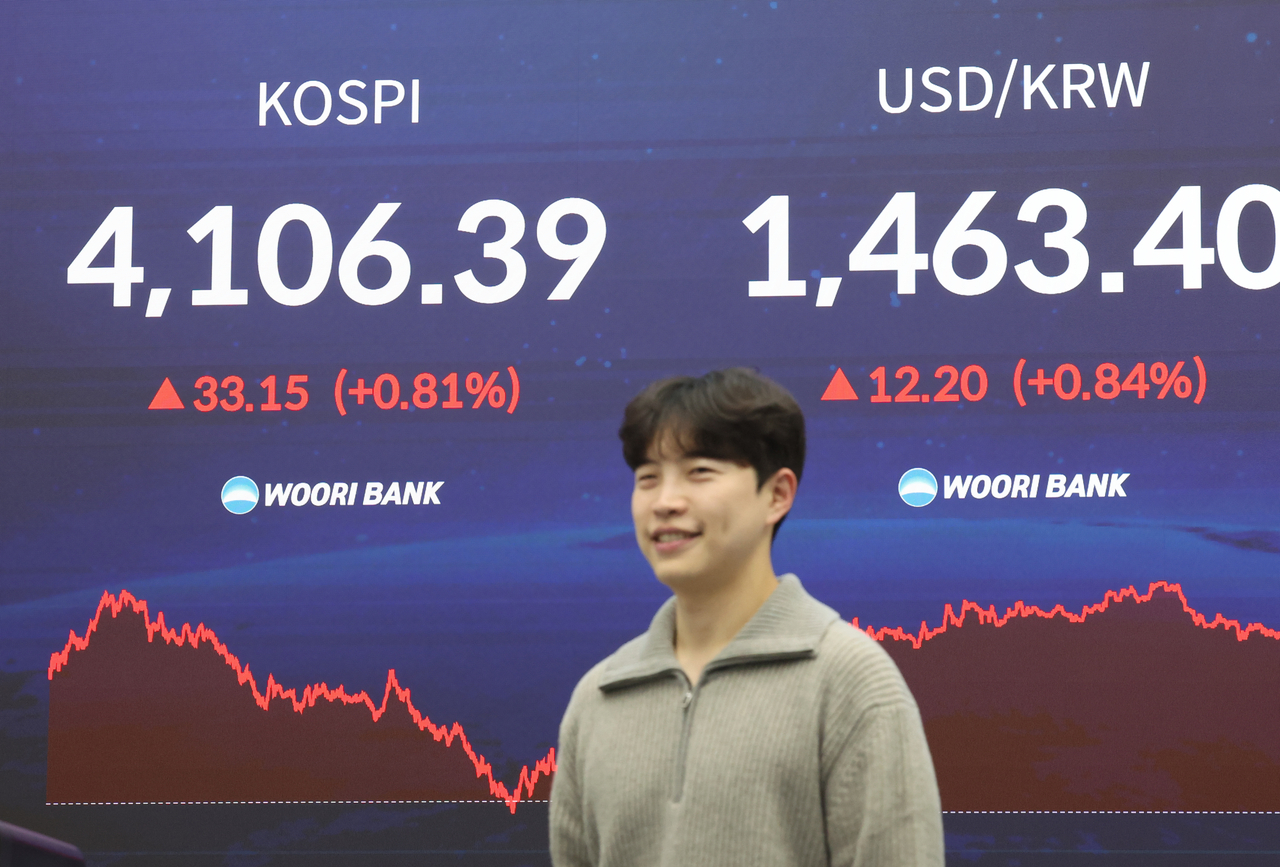
The narrowing of differences between the government and ruling party comes as policymakers seek new levers to sustain market momentum. The Kospi has shown signs of fatigue after climbing past 4,200 points this month, with sentiment cooling and foreign funds starting to pull out.
On Monday, news of the weekend agreement to lower the top rate helped the Kospi rebound from its earlier slide, led by gains in high-dividend stocks such as financials, and extend its rally for three straight sessions through Wednesday.
Supporters argue the reform is part of a broader effort to improve shareholder returns and corporate transparency. “The point isn’t the direct tax benefit,” said one market analyst, who requested anonymity, “but the policy’s ability to steer corporate behavior and sentiment toward a more pro-investor environment.”
He added that such efforts take time. “Japan’s value-up drive took a decade. Korea’s may take longer, but it sends a positive signal on where policy is headed.”
On Thursday, the National Assembly’s Strategy and Finance Committee will begin a joint review of the new dividend tax scheme and other government tax reform proposals at its tax subcommittee meeting.
jwc@heraldcorp.com