Sources highlight automaker’s symbolic gesture to ease US concerns, not a shift in battery strategy
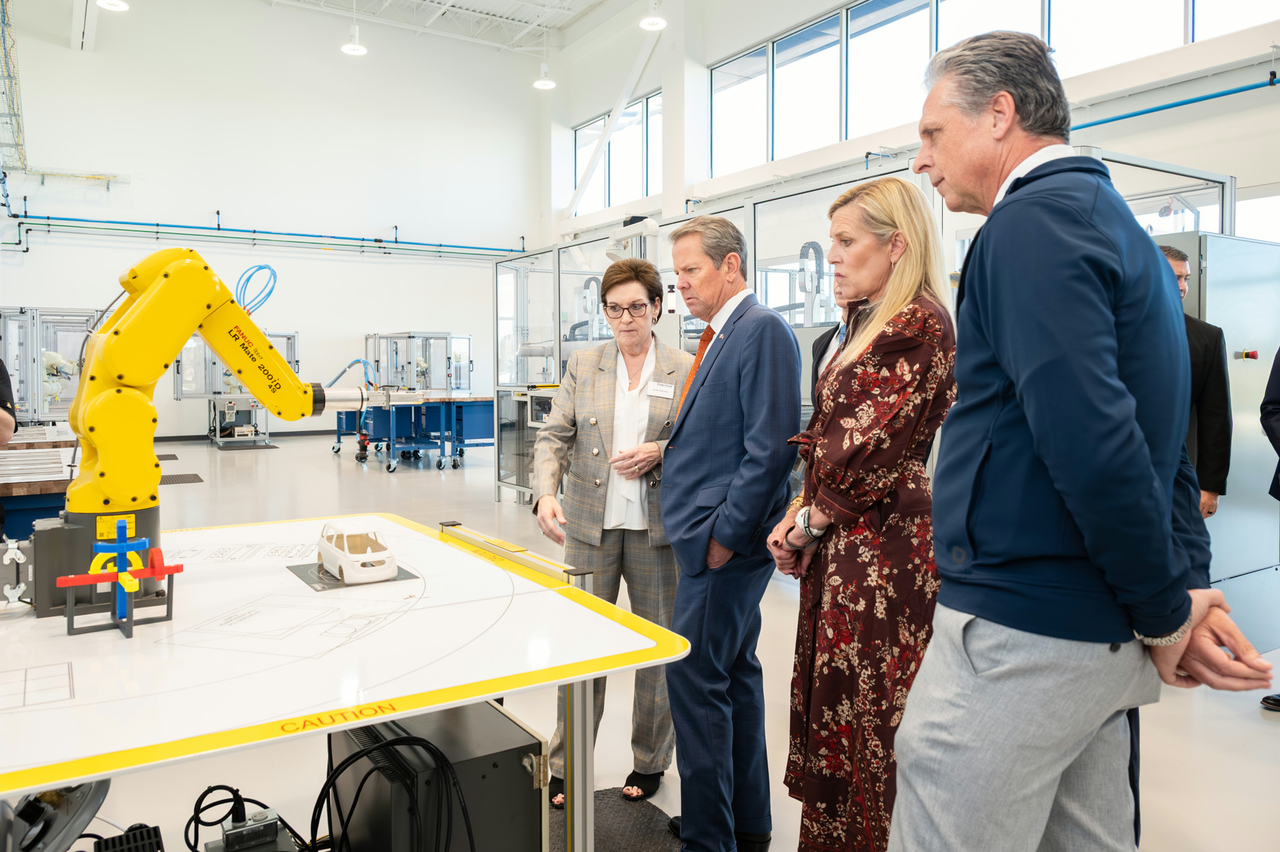
Just over two months after a US immigration raid on Hyundai Motor Group and LG Energy Solution’s joint battery plant in Georgia, the Korean automaker moves to reinforce its commitment to local workforce development, opening a training center in the same state as part of its $12.6 billion investment pledge.
The 26,700-square-meter Hyundai Mobility Training Center of Georgia, launched last week, will be the core facility for Hyundai Motor Group Metaplant America and its five affiliates, training over 800 workers at a time in next-generation mobility production, including electric and hybrid vehicles.
The initiative comes amid Washington's push for stronger domestic labor practices following the raid, which exposed concerns over labor sourcing and compliance at foreign-owned manufacturing sites.
While the new center shows Hyundai’s intent to align with the Trump administration’s call to “hire and train American workers,” industry observers say its focus on EV safety and assembly instead of battery cell production could be due to the sensitive nature of the battery supply chain.
Hyundai’s EV training push
According to Hyundai Motor Company America, the facility was established in partnership with Georgia Quick Start, the state’s workforce development initiative under the Technical College System of Georgia. It supports Hyundai’s plan to create roughly 8,500 jobs in Georgia by 2031 and deepen the state’s EV manufacturing base.
The center includes five specialized training zones: a production skills lab, an immersive conveyor and assembly simulator, a VR safety lab, and an automation and mechatronics lab for industrial control systems.
At its core is the High Voltage Battery and Safety Lab — the first in the state dedicated to EV systems — designed to provide hands-on training with real high-voltage battery modules, wiring harnesses and power electronics.
Hyundai said the curriculum underscores its goal of building a skilled local workforce in advanced manufacturing, aligning with Washington's calls to “hire and train American workers.” Although US President Donald Trump did not explicitly reference EV battery systems in his post-raid remarks, his comments were widely interpreted as urging automakers to expand domestic training in high-tech sectors.
Hyundai Motor Group’s Seoul headquarters dismissed speculation that the battery-safety program was created under US pressure, emphasizing that it was part of its preexisting $12.6 billion investment commitment with the Georgia government to construct HMGMA and expand the state’s EV ecosystem. The move mirrors Kia’s earlier decision to open a state-supported training center alongside its vehicle assembly plant in West Point, Georgia, in 2008.
‘Battery safety, not battery tech’
Industry insiders say that while the program’s “battery safety” focus may symbolically address US concerns, it does not directly reflect the in-depth training the US government may be seeking for EV battery cells. The lab is designed more for workers at Hyundai’s vehicle assembly operations than those at the joint battery plant with LG Energy Solution.
“From a technical standpoint, the lab is closer to a research-oriented safety facility, providing controlled experiments on high-voltage stability and failure prevention — key to ensuring battery and material durability,” said a source who previously worked at an overseas subsidiary of a Korean battery company.
“The program could not have included cell-manufacturing training, as that area remains exclusively within the domain of battery suppliers such as LG Energy Solution, not Hyundai.”
Lee Hang-koo, advisor at the state-run Korea Automotive Technology Institute, echoed this view.
“Jobs in battery cell manufacturing are not ordinary production roles but highly specialized positions tied to nationally strategic technologies. For that reason, LG Energy Solution would find it difficult to engage in joint training programs with Hyundai on such sensitive areas.”
“While a 1 billion won ($681,300) investment in an internal combustion vehicle plant typically created six to seven jobs, EV production generates only about two, and battery manufacturing even fewer,” Lee added.
“Therefore, LG Energy Solution has little incentive to devote significant time and resources to large-scale local workforce training, as it would be economically inefficient.”
hyejin2@heraldcorp.com