Government, ruling party agree on 53-61% emissions reduction despite industry
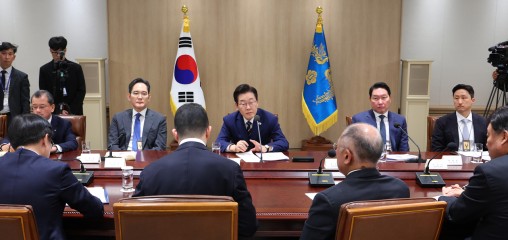
The government and the ruling Democratic Party of Korea on Sunday reached a consensus on setting the nation's 2035 goal for reducing greenhouse gas emissions at between 53 and 61 percent of 2018 levels.
All countries that signed the 2015 Paris Agreement on climate are required to update their goals, called "Nationally Determined Contributions," every five years.
The government plans to finalize the NDC proposal this week and submit it to the United Nations next week. Once submitted, the goal cannot be scaled down.
The nation's industries say that even a 47 percent minimum reduction is too high. They complain that the 40 percent NDC goal already set for 2030 would not be easy to meet.
Manufacturing industries are major sources of carbon emissions, and the Korean economy is manufacturing-oriented, so an overly ambitious NDC goal could directly hit corporate competitiveness.
Four industries alone — steel, oil refining, cement and petrochemicals — are expected to buy about 5 trillion won ($3.4 billion) of additional greenhouse gas emission allowances from 2026 to 2030. Entities that emit more than their allowance must buy credits to cover their excess emissions. Industries worry that if a higher NDC for the 2030-2035 period is imposed, the burden could become unbearable.
It is evident that greenhouse gas emission reductions are an unstoppable trend of the times, but the sharply upward NDC adjustment could be a serious threat to the sustainability of the nation's industries.
Everything should be done in moderation. South Korea accounts for 1.4 percent of the world's greenhouse gas emissions. Its impact is very small in terms of the global total.
China pledged in September to cut greenhouse gas emissions by 7 to 10 percent by 2035. US President Donald Trump has argued that the Paris deal was unfair to the US. In January, Trump signed an executive order for the US to withdraw from the agreement.
The world's two largest emitters, whose combined emissions make up nearly 40 percent of the global total, do not seem particularly interested in pulling their weight. Korea is trying to take the initiative to reduce global greenhouse gas emissions, at the risk of harming its economy, even though its share of emissions is a mere 1.4 percent.
Critics question whether the 2035 goal has fully considered the future with demand for electricity expected to surge in the age of artificial intelligence. AI computing consumes a lot of electricity. If the nation raises its greenhouse gas reduction goal, nuclear energy would be the best answer, because nuclear power plants generate large amounts of electricity without directly burning fossil fuels.
However, the government is committed to reducing both greenhouse gas emissions and energy consumption, while hesitating on nuclear power plants and vowing to pave "AI highways." The government's disjointed decisions bewilder the public.
The Ministry of Climate, Energy and Environment on Wednesday vowed to reduce the nation's total energy consumption to just below current levels by 2029. Last month, the Nuclear Safety and Security Commission postponed its decision again on whether to extend the life of the Kori Nuclear Power Plant Unit No. 2. The government has not yet stepped out of the shadows of the previous liberal Moon Jae-in government's nuclear phase-out policy.
Korea's NDC issue last came to the fore under the Moon government. It promised a 40 percent reduction for 2030 without fully examining the possibility of realizing such a high goal — apparently out of eagerness for praise from the international community.
The Lee Jae Myung administration is lukewarm about the use of nuclear energy and tends to be obsessed with renewables, which are not well suited to Korea's geographical features.
Korea's NDC goal needs to be readjusted to a realistic level before being submitted to the UN. If the government sticks to it nonetheless, it must take a more flexible attitude toward the use of nuclear energy.
khnews@heraldcorp.com