South Korea stands again at an inflection point as technology, ambition and geopolitics intertwine with the dawn of the “age of physical AI,” when artificial intelligence leaps out of servers and screens into robots, vehicles and factory floors. The timing could hardly be more symbolic for a nation that, built on manufacturing prowess, now attempts to merge its industrial DNA with the algorithms shaping the 21st-century economy.
The headlines, filled with meetings and handshakes between President Lee Jae Myung and AI chip giant Nvidia’s Chief Executive Jensen Huang, captured the surface drama for the past several days. But beneath the stage lights lies a subtler question of whether South Korea can truly master this fusion or will end up merely a high-tech subcontractor to global giants.
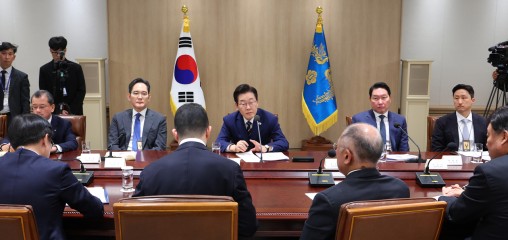
During the Asia-Pacific Economic Cooperation summit, Seoul unveiled a parallel script in which Nvidia agreed to supply massive computing capacity and join national AI projects involving such top-profile conglomerates as Samsung Group, Hyundai Motor Group, SK Group, and Naver.
The arrangements appear to promise benefits for all, with Nvidia gaining scale and legitimacy in industrial AI, South Korea securing access to large amounts of the world’s most advanced chips, and the global AI community benefiting from the outcome of the fusion of intelligence and machinery.
During the APEC summit, Seoul also advanced on the diplomatic front, agreeing with the US to expand cooperation in AI, 6G, quantum computing, biotechnology and space. At the same time, it persuaded the US, China and APEC’s other 18 member economies to endorse its proposal to coordinate efforts to harness AI innovation responsibly across the region.
Together, these initiatives will quadruple South Korea’s AI computing power to more than 300,000 high-performance graphics processing units, creating one of the world’s densest clusters, and strengthen the country’s diplomatic leverage in the Asia-Pacific region and its technology partnership with Washington, reinforcing its status as a central node in the global AI supply chain.
For policymakers, “physical AI” is not just another buzzword but the technological antidote to deep structural woes such as a shrinking workforce, stagnant productivity and intensifying Chinese competition. Robots guided by AI algorithms could assemble products and manage factories, transforming the productivity frontier of an aging economy.
To institutionalize this vision, the government has recently launched the Physical AI Global Alliance, linking researchers, conglomerates and foreign partners in areas such as robotics, autonomous mobility and smart manufacturing.
Nvidia’s Huang also offered a succinct validation by saying, “When you combine software, AI technology and manufacturing, you have the opportunity to truly take advantage of robotics.” Few countries can boast such an integrated stack — chips from Samsung Electronics and SK hynix, robots and digital twins from Hyundai Motor Group and SK Group, and large language models from Naver and LG AI Research.
South Korea’s pact with Nvidia grants access to the world’s fastest AI hardware at scale but simultaneously risks binding the nation’s innovation to a single corporate ecosystem whose ambitions, though partially aligned with Seoul’s, could ultimately diverge in ways that may constrain technological independence and strategic autonomy.
Partnerships and sovereignty
This may not end up as just a hardware purchase deal but as a national gambit because, if Nvidia’s hardware and software become a core part of the nervous system controlling South Korea’s physical AI, then the country’s sovereignty over its own intelligence could weaken significantly.
As Nvidia’s move to form partnerships with South Korea closely followed the US administration’s tightening of export controls on advanced chips to China, South Korea’s computing backbone could suddenly hinge on decisions made abroad.
To avoid becoming a testing ground for foreign AI giants, South Korea must balance global cooperation with the cultivation of strong domestic alternatives.
In practice, this means developing indigenous neural-processing units, expanding sovereign cloud infrastructure and creating homegrown foundation models tuned for industrial data. Unlike language models, physical AI depends on highly specific data streams from factories, sensors and machines. Whoever controls that data controls the future of intelligent manufacturing.
South Korean factories have accumulated mountains of operational data, but much of it remains locked in silos or outsourced to vendors. To build genuine sovereignty, that data must be integrated, anonymized, and reused as training fuel for local AI models. Nvidia’s GPUs may have given Korea wings — but wings, by themselves, determine neither altitude nor direction.
South Korea’s AI master plan brims with ambition — quantum computing, 6G, biotechnology, even space — but what South Korea needs now is not another grand slogan but a clearer understanding of where and why it wishes to lead.
Each of the goals demands different capital, expertise and risk tolerance, and strategy is not about expanding the map but about choosing the road. Celebrating progress too early could obscure the risks, and the very intelligence South Korea exports may, in time, belong to someone else.
Hardware alone cannot secure independence, as while GPUs can be bought, talent must be nurtured. Universities and startups need the freedom to experiment and fail — a culture often constrained by hierarchy and short-term budgets. The true race, then, is not for machines but for minds.
Cooperation with Washington, Tokyo and global tech firms places Seoul at the heart of global technology governance, and its success in persuading APEC members to endorse a new AI initiative was an understated but significant step. Yet South Korea’s leverage will endure only if it remains an indispensable innovator, not a dependent consumer.
For all the triumphalist rhetoric, what South Korea needs most is strategic humility, for foreign technology should serve as a bridge to self-reliance, not a crutch for complacency. The real test lies in whether Seoul can turn its hardware strength into intellectual sovereignty, building not only robots and chips but also the institutions and imagination that give them purpose.
In the age of physical intelligence, direction — not speed — will decide the flight.
Yoo Choon-sik
Yoo Choon-sik worked for nearly 30 years at Reuters, including as the chief Korea economics correspondent, and briefly worked as a business strategy consultant. The views expressed here are the writer’s own. — Ed.
khnews@heraldcorp.com