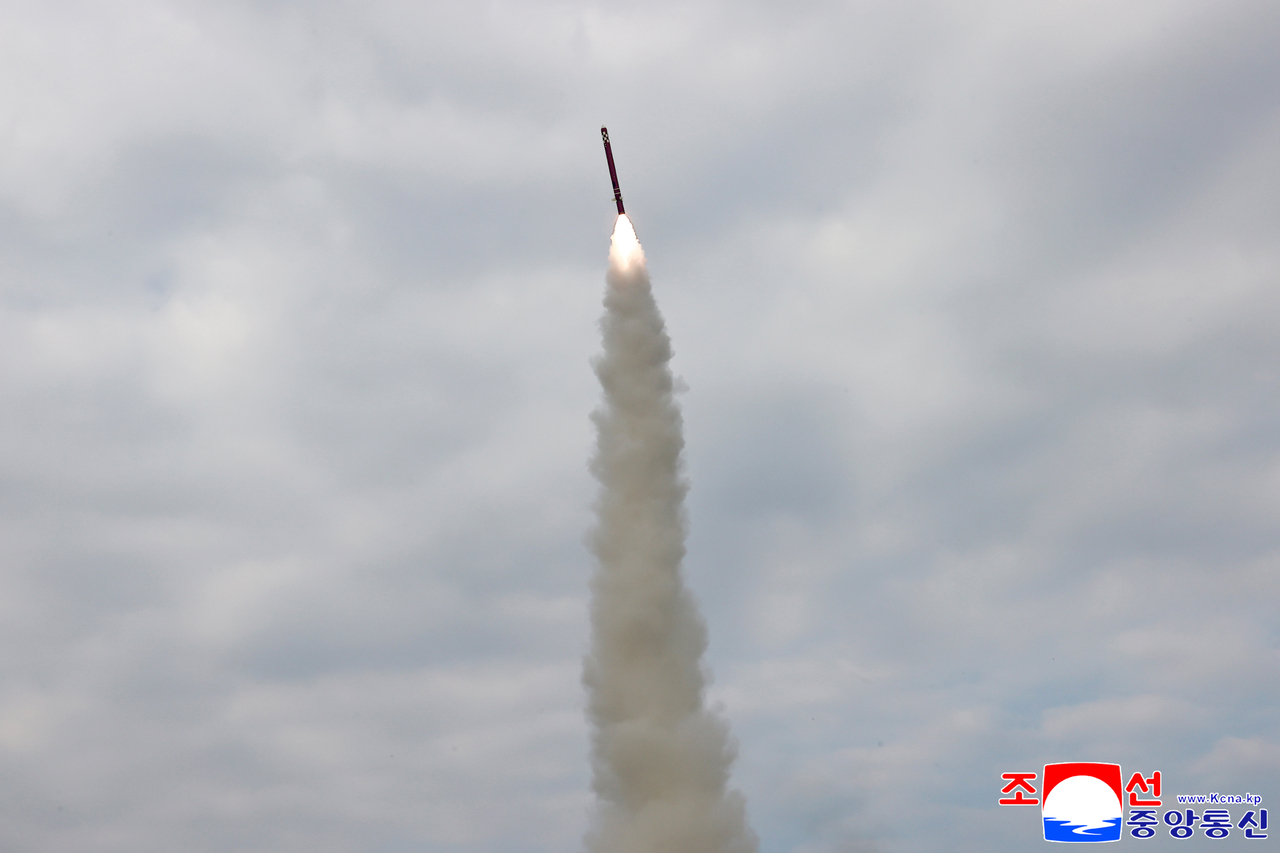
North Korea fired at least one suspected ballistic missile toward the East Sea on Friday, in what observers say appears to be a protest against the latest US sanctions.
According to South Korea's Joint Chiefs of Staff, the launch took place around 12:35 p.m. from Daegwan, North Pyongan Province.
The projectile, assessed to be a short-range ballistic type, traveled roughly 700 kilometers before falling into the East Sea, according to the JCS. Authorities in South Korea and the United States are conducting a joint analysis to determine the specific model and flight characteristics.
The JCS said the military has strengthened its surveillance and readiness posture while sharing real-time information with the US and Japan to prepare for any additional launches.
Friday’s launch marks North Korea’s seventh ballistic missile test this year and the second since President Lee Jae Myung took office in June. It also came just 16 days after the North’s previous short-range ballistic missile test on Oct. 22, carried out ahead of the Asia-Pacific Economic Cooperation summit in South Korea and US President Donald Trump’s visit.
The latest provocation is seen as Pyongyang’s response to Washington’s renewed pressure campaign on Pyongyang's cybercrime networks. Earlier this week, the US Treasury Department announced sanctions on eight North Korean nationals and two entities for involvement in laundering illicit cyber proceeds. The US State Department also said it would push for UN sanctions on seven foreign vessels accused of facilitating North Korea’s coal and iron ore exports to China.
Some experts also see a broader signal linked to American strategic deployments in the region.
Yang Moo-jin, a professor at the University of North Korean Studies, said the 700-kilometer range indicates the missile was designed for use within the Korean Peninsula. “It is unlikely that the launch was a direct response to US sanctions,” Yang said. “Rather, it appears to be a show of force timed with the arrival of the USS George Washington in Busan, signaling opposition to upcoming joint military drills.”
The US Navy’s nuclear-powered aircraft carrier USS George Washington (CVN-73) arrived at Busan Naval Base on Wednesday for what the Navy described as a routine port call for resupply and crew rest. The timing of the visit, however, was aligned South Korea-US Security Consultative Meeting held Tuesday in Seoul and was seen as a demonstration of alliance deterrence against North Korean threats.
The 100,000-ton Nimitz-class carrier is accompanied by three other vessels — the cruiser USS Robert Smalls and the Aegis destroyers USS Milius and USS Shoup. The carrier is capable of carrying more than 80 aircraft, including F-35C stealth fighters, F/A-18 Super Hornets, E-2C Hawkeye early-warning aircraft and MH-60R helicopters.
Japan’s government said Friday's missile appeared to have landed outside its exclusive economic zone, with no immediate reports of damage. Prime Minister Sanae Takaichi said Tokyo had entered an emergency response posture and was working closely with Seoul and Washington to gather information and ensure public safety, according to Kyodo News and other Japanese media.
mkjung@heraldcorp.com