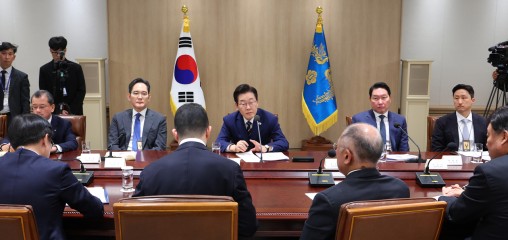
The APEC summit held last week in Gyeongju, North Gyeongsang Province, brought South Korea several diplomatic gifts.
Through his summit with US President Donald Trump, President Lee Jae-myung secured concessions regarding US tariffs and investment issues, while his meeting with Chinese President Xi Jinping resulted in what both sides called a “full restoration of bilateral relations.” Lee also met Japan’s new Prime Minister Sanae Takaichi, reaffirming their commitment to maintaining friendly ties. Gyeongju received the global spotlight as a venue for the historic Trump-Xi summit.
Domestically, these achievements can be viewed as notable diplomatic successes. But as the chair of the multilateral Asia-Pacific Economic Cooperation forum, questions remain as to whether the Korean government fulfilled its international role. The summit produced no meaningful commitment to the principle of regional free trade that APEC was founded to advance.
Since its establishment in Australia in 1989 with 21 members, APEC’s guiding principle has been “free and open trade and investment in the Asia-Pacific region.” Under this banner, APEC has achieved remarkable progress over the past 36 years, reducing the region’s average tariff rate from 17 percent to under 5 percent and raising intraregional trade from 50 percent to roughly two-thirds of total trade volume.
Yet, the final Gyeongju Declaration issued at the close of this year’s summit stated only that “robust trade and investment are vital to the growth and prosperity of the Asia-Pacific region,” without a single mention of free trade.
Behind this omission was, of course, the protectionist stance of the Trump administration.
Reports suggest that US Treasury Secretary Scott Bessent opposed the inclusion of the phrase during negotiations over the final draft. Now in his second term, Trump continues to use tariffs and trade barriers as tools to pressure countries around the world. He believes that multilateral trade systems such as the WTO have undermined the US economy while enriching its trading partners, and that only one-on-one bilateral negotiations can truly serve America’s interests.
Given Washington’s hard-line position, the limits of Korea’s role as host may be understandable. Yet it remains disappointing that Korea — one of the greatest beneficiaries of borderless, free trade — failed to uphold APEC’s core value even symbolically in the final communique. As a middle power aspiring to global leadership, Korea had a moral responsibility to ensure that free trade was reaffirmed in writing.
Under the lofty theme “Building a Sustainable Tomorrow: Connect, Innovate, Prosper,” the Gyeongju APEC meeting was not without achievements.
The Digital and AI Ministers’ Meeting placed artificial intelligence cooperation at the center of the agenda, and the declaration pledged to harness the potential of AI to enhance competitiveness and address common challenges among member economies.
At the Labor Ministers’ Meeting, members also agreed — upon Korea’s proposal — to establish a new APEC Sustainable Jobs Forum to strengthen cooperation in adapting to demographic changes and restructuring labor markets.
In a surprising move, the declaration also included references to cultural industries, stating that “dialogue and cooperation on Culture and Creative Industries among APEC members will contribute to economic growth in the region.” This was widely viewed as an effort by Korea to elevate the status of its cultural sector internationally. Park Jin-young, head of JYP Entertainment and chair of the Korea Popular Culture Exchange Committee, was even credited with helping create space for lifting China’s ban on Korean pop culture through his conversation with Xi.
Still, APEC is, at its core, a multilateral forum on trade and investment. A summit that sidestepped these central issues will struggle to be regarded as a major international success.
The Gyeongju meeting is more likely to be remembered as a stage that reaffirmed the sharp divide between emerging economies like China, which advocate free trade, and advanced economies such as the United States, which push for regulated and protectionist trade. It is quite ironic that the US, formerly the champion of free trade, now endeavors to limit free trade, while China hopes to promote it.
Unfortunately, the Gyeongju summit will not be remembered as a forum that upheld its core principles and values. What will linger in memory, perhaps, are the historic photo ops of Lee’s meetings with Trump and Xi. Korea, as host, may be credited for running the event smoothly, but not necessarily for demonstrating genuine leadership as the chair of a multilateral forum.
Nations host major multilateral summits to showcase their global presence and enhance their influence on the world stage. The 2024 Rio G20 Declaration, the 2015 Paris Climate Agreement and the 1997 Kyoto Protocol are remembered as landmark achievements of such gatherings.
What memory will the 2025 Gyeongju APEC summit leave behind?
Will it be remembered as a meeting that shaped the future of the international trading order — one of the most pressing issues of our time?
Or will it be remembered for the moment when Trump, despite the “No Kings” movement spreading across America against his authoritarian governance, gleefully accepted a gold crown as a gift from Lee?
Lee Byung-jong
Lee Byung-jong is a former Seoul correspondent for Newsweek, The Associated Press and Bloomberg News. He is a professor at the School of Global Service at Sookmyung Women’s University in Seoul. The views expressed here are the writer’s own. — Ed.
khnews@heraldcorp.com