Seoul limited to conventional arms; no rush in retaking OPCON
President Lee Jae Myung said Tuesday that South Korea's plan to retake wartime operational control, or OPCON, from the United States "within his term" would serve as a major opportunity to upgrade the bilateral alliance.
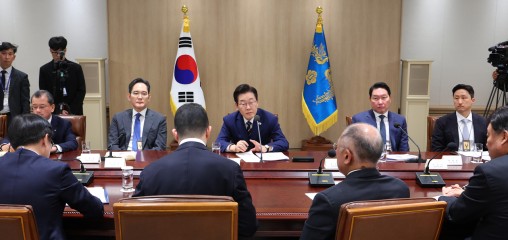
Lee made the remarks during a meeting at his office with US Defense Secretary Pete Hegseth. His five-year term ends in 2030.
Earlier in the day, after annual security talks with South Korean Defense Minister Ahn Gyu-back in Seoul, Hegseth told reporters that the two agreed that Seoul's commitment to increase defense spending would bolster South Korea's ability to lead its conventional deterrence against North Korea. Hegseth also said that "we would certainly continue to extend nuclear deterrence as we have before."
His remarks indicate that Seoul will play a bigger role in the alliance's defense against North Korea's conventional weapons, while Washington will continue to extend nuclear deterrence against the North's nuclear threats.
When asked whether US troops stationed in South Korea might be used in any conflicts beyond the Korean Peninsula, including with China, Hegseth said that "there's no doubt that flexibility for regional contingency is something we would take a look at."
Washington apparently wants Seoul to increase its conventional deterrence so that it can focus more on China.
Against this backdrop, Lee appears to be in a rush to retake OPCON. He has emphasized a self-reliant defense. In a speech that day on next year's government budget plan, he said, "Our people's pride will be undermined if South Korea, ranked fifth in global military strength, continues to rely on foreign nations for its defense."
Considering that the US intends to use its forces in South Korea to hold China in check as well as to deter North Korea, and that OPCON is directly connected to Korean people's lives, Seoul needs to be careful about regaining it.
South Korea still relies on US forces, especially in key capabilities such as reconnaissance, surveillance and missile interception. An early retaking of OPCON might create a hole in South Korea's defenses.
Many Koreans have misgivings about whether a self-reliant military will be able to defend them from North Korea's attacks.
Even if the South Korean government raises its defense spending to 3.5 percent of gross domestic product by 2035 as demanded by Washington, there will be limitations in maintaining a military capability at the level that the US has so far provided to the peninsula.
There is practically zero chance that South Korea will obtain its own nuclear weapons. South Korean Defense Minister Ahn emphasized in the press conference after the talks with Hegseth that South Korea, as a party to the Nuclear Non-Proliferation Treaty, "cannot and will not possess nuclear arms." Self-reliant defense would be a dangerous illusion without nuclear weapons of its own or help from foreign nations when it is under nuclear threat.
Under the Lee administration, joint Korea-US military drills have been postponed or scaled down. Combined exercises are a key element of OPCON transfer. More joint drills are needed for a Korean four-star general to be able to command combined forces after retaking wartime operational control.
OPCON should be transferred at some point in the future when all necessary conditions are met. Reportedly, the second of three stages of evaluating conditions for the transfer is underway. This procedure must not be done in haste due to political considerations.
The self-reliant defense of a sovereign state is a cause that's hard to oppose, but it cannot be accomplished on the basis of ideology alone. The transfer conditions must be sufficiently met.
What is more important than the speed of retaking OPCON is building up trust in the alliance, not weakening it. The goal of wartime operational control should lie in securing the ability to fully deter North Korea's nuclear threats.
khnews@heraldcorp.com