
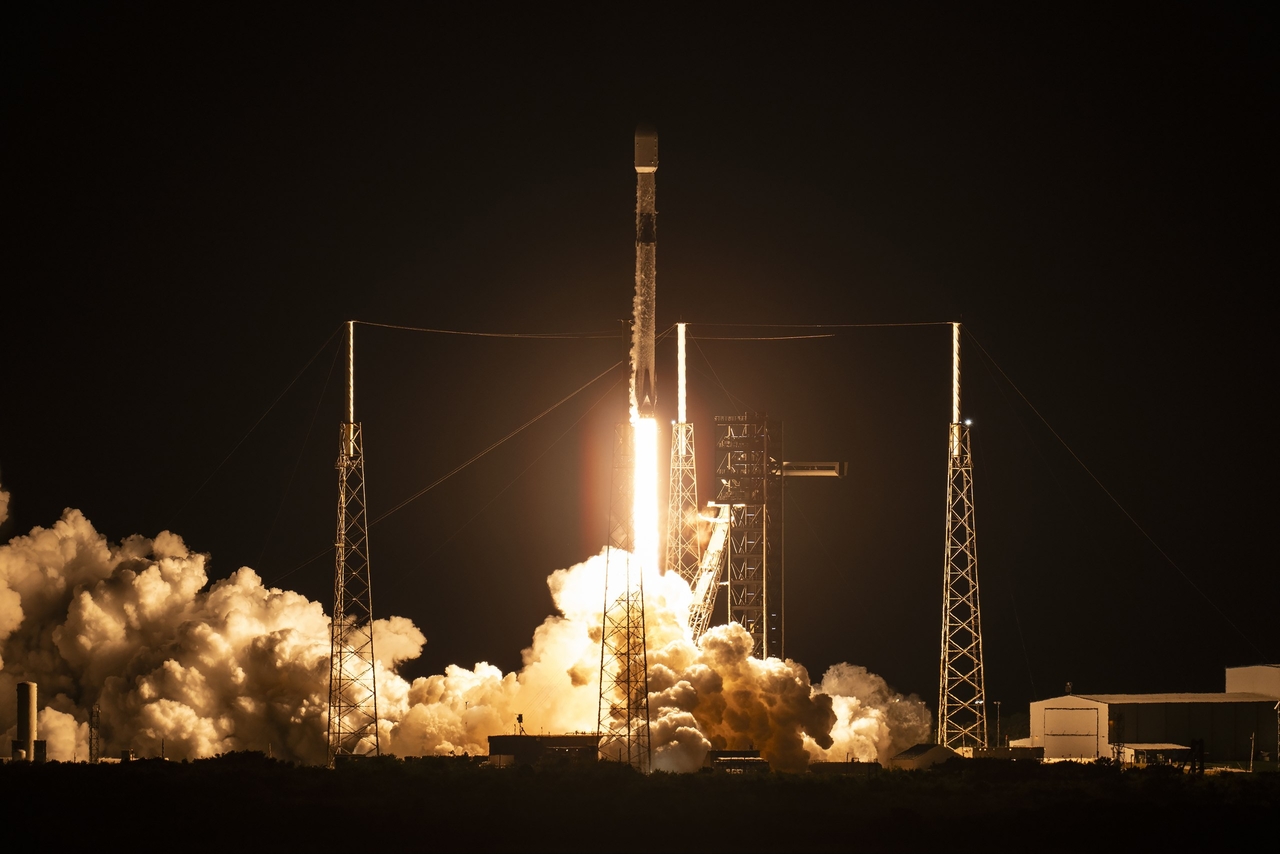
South Korea on Sunday launched its fifth military reconnaissance satellite, completing the nation’s space-based surveillance network designed to strengthen its independent intelligence and early-warning capabilities against North Korean threats.
The satellite — referred to as the “final eye” of South Korea’s Kill Chain preemptive strike system — lifted off aboard a SpaceX Falcon 9 rocket from Cape Canaveral Space Force Station in Florida at 1:09 a.m. — 2:09 p.m. in South Korea — according to Seoul’s Defense Ministry.
About 14 minutes after liftoff, the synthetic aperture radar satellite successfully separated from the rocket and entered its target orbit. Roughly an hour later, the ministry confirmed that it had made stable contact with a ground control station, indicating normal operation.
The launch marks the completion of the “425 Project,” a decadelong program initiated in 2013 for South Korea to achieve independent space-based reconnaissance capability and to reduce its reliance on US satellite imagery. The “425” in the name combines the Korean pronunciation of its five-satellite composition: four SAR satellites and one electro-optical/infrared satellite.
The first EO/IR satellite was launched in December 2023, followed by four radar satellites between April 2024 and February 2025, all carried by SpaceX’s reusable Falcon 9 rockets.
“With this launch, the military can now conduct independent, all-weather surveillance and reconnaissance across the Korean Peninsula by operating the satellites as a cluster,” the ministry said.
Once all five satellites are fully operational, the constellation will enable the military to monitor North Korea at roughly two-hour intervals. The SAR satellites are equipped with sensors capable of identifying ground objects as small as 30 centimeters, allowing detailed observation of missile facilities and troop movements regardless of weather or lighting conditions.
Currently, satellites No. 1 through 3 have completed deployment, while No. 4 is undergoing operational evaluation. The fifth satellite will soon begin testing and performance assessments before entering full service.
“The successful launch of the fifth satellite allows our military to establish an independent surveillance and reconnaissance capability over the entire Korean Peninsula,” the ministry said in a statement.
“It will not stop here — the military plans to further strengthen self-reliant defense by developing small satellites and securing domestic launch sites and rockets to support future space operations.”
The constellation forms a key component of South Korea’s three-axis defense system — encompassing preemptive strike (Kill Chain), missile defense and retaliatory response — by enabling faster and more accurate detection of possible North Korean provocations.
Observers say the milestone underscores Seoul’s growing emphasis on space security as part of a broader deterrence architecture on the Korean Peninsula.
Meanwhile, North Korea has been racing to expand its own reconnaissance program. It successfully launched its first military spy satellite, Malligyong-1, in November 2023 and pledged to send three more into orbit in 2024. However, its most recent attempt in May 2024 ended in failure when a rocket exploded shortly after takeoff.
Seoul’s Defense Ministry emphasized that the 425 Project represents not only a technological breakthrough, but also a strategic shift toward self-reliant defense. With the constellation now in place, South Korea joins a select group of nations capable of conducting continuous, independent reconnaissance from space.
Officials say future goals include developing miniaturized satellite constellations, expanding space launch infrastructure and integrating civilian-military cooperation in the emerging aerospace defense sector.
“By securing our own eyes in space, we can detect threats faster and respond with greater precision,” one defense official said. “It’s a foundation for true strategic autonomy.”
mkjung@heraldcorp.com