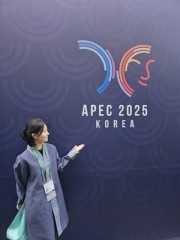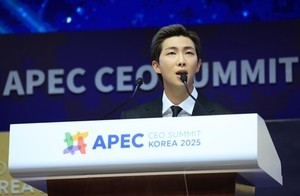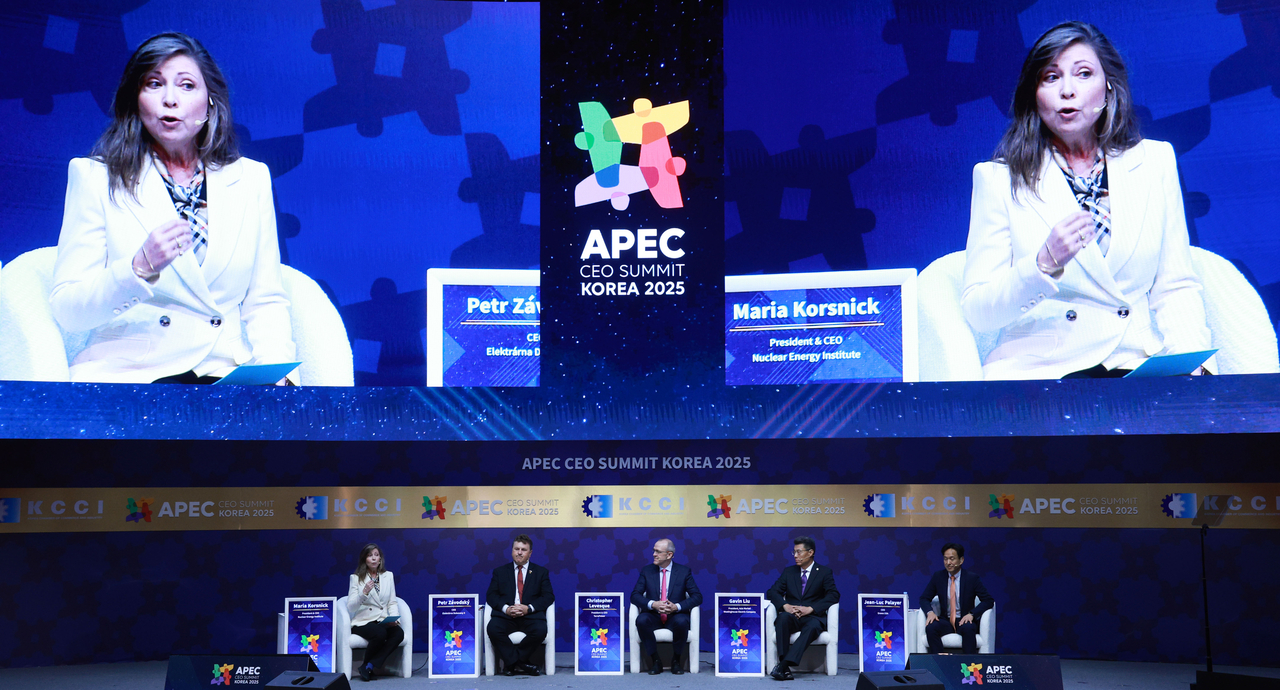
GYEONGJU, North Gyeongsang Province — With artificial intelligence adding explosive demand to the already surging electricity needs driven by digitalization, electrified transport and industrial transformation, nuclear power is reemerging as a crucial solution, industry leaders said during a panel discussion at the APEC CEO Summit, Friday.
“Nuclear energy delivers large-scale, stable electricity without carbon emissions, making it a vital component of a balanced energy mix for AI industries,” said Cho Seok-jin, chief nuclear officer of Korea Hydro & Nuclear Power, in his keynote speech. "In the data centers, in particular, continuous and reliable baseload power is essential."
The following panel session, moderated by Maria Korsnick, president and CEO of the Nuclear Energy Institute, brought together figures from the global nuclear sector: Elektrarna Dukovany II CEO Petr Zavodsky, TerraPower CEO Christopher Levesque, Westinghouse Electric Company President Gavin Liu, in charge of the Asia market, and Jean-Luc Palayer, CEO of Orano USA.
IAEA Director General Rafael Mariano Grossi highlighted the importance of nuclear energy in a prerecorded opening remark.
“Data centers already use 1.5 percent of global electricity and that share is growing by more than 10 percent every year. Amazon, Microsoft, Google and Meta, all the big names, are signing power purchase agreements and exploring other ways for nuclear energy to power their AI data centers,” Mariano said.
"The world reached a clear consensus that nuclear power must play a central role in providing the low-carbon energy that fuels our future."
Levesque of TerraPower — a US small-modular reactor company founded by Bill Gates — explained his company's mission was to "help countries with rapidly growing populations overcome energy poverty by building nuclear plants."
The Terrapower chief said the company plans to deliver the first reactor in 2031, and that, by the mid-2030s, it will be delivering up to 10 natrium units per year around the world.
The chiefs also highlighted the importance of collaboration as the enabler for the industry's sustainability.
"For nuclear exports, Westinghouse's strategy emphasized a sustained collaboration with the (technology transfer) recipient country," Liu said.
"The partnership (with Korea) continues to evolve, and building on the 50 years of trust with Team Korea, we have been working together to successfully deliver the APR-1400 to the UAE, and now we are working together, making similar efforts in the Czech Republic."
Zavodsky of the Elektrarna Dukovany II also mentioned the landmark $18 billion contract with KHNP to build two nuclear reactors in the Czech Republic in June.
"KHNP's offer was the closest to our needs, so we do believe that we can build our reactor units on time, on budget at Dukovany," Zavodsky said.
"We are (currently) talking about two units there (at Dukovany), but we still have options at Temelin. So hopefully we will build four APR-1000 reactors in the Czech Republic," Zavodsky said, raising anticipation for further collaboration with the Korean state agency to build two additional reactors in the Temelin region.
herim@heraldcorp.com