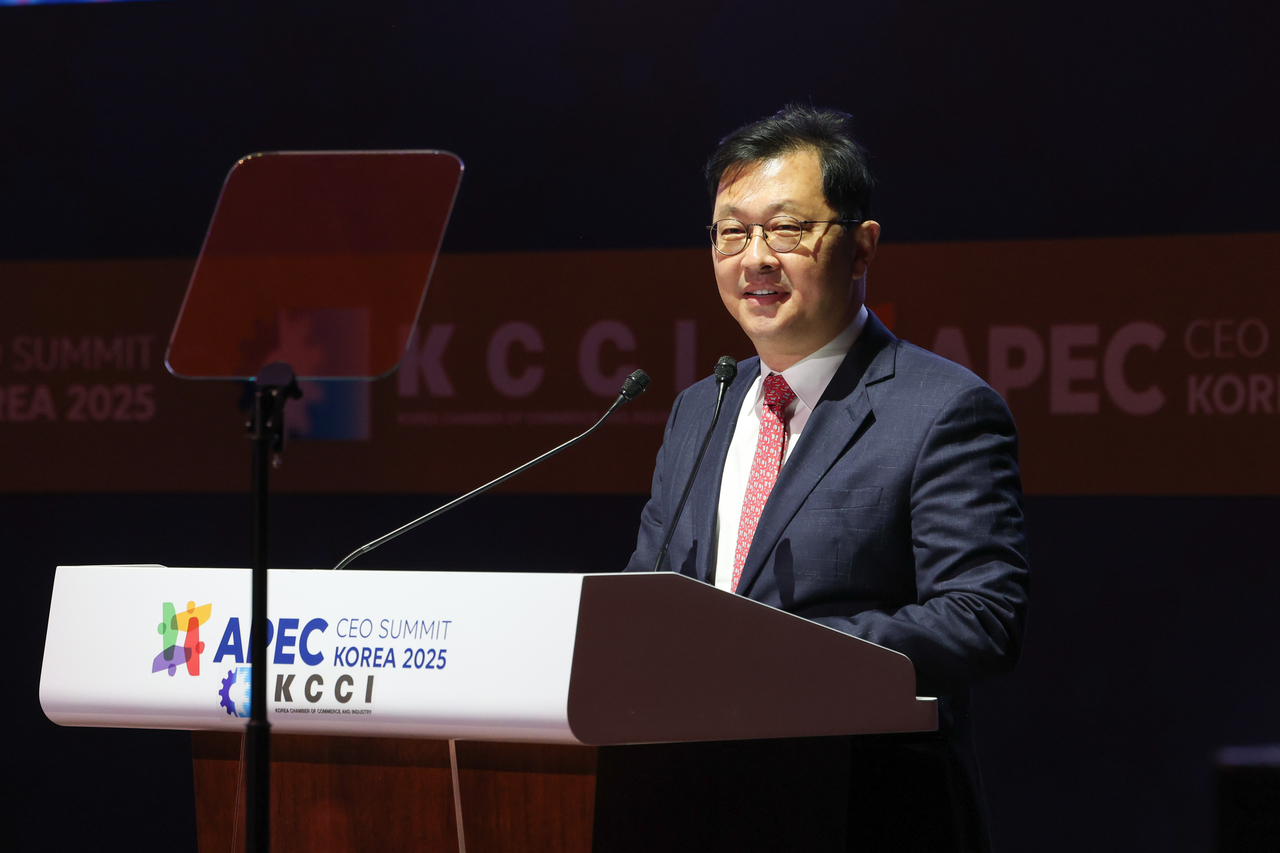
GYEONGJU, North Gyeongsang Province — Liquefied natural gas should no longer be seen as a transitional solution, but as a key “partner fuel” powering the energy-intensive artificial intelligence era, said SK Group Executive Vice Chair Chey Jae-won, calling for greater international cooperation to ensure cleaner and more sustainable energy supplies.
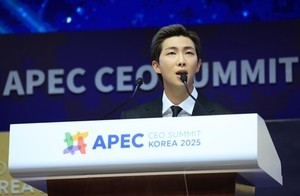
“AI runs on power, energy,” said Chey during a session titled “Asia Pacific LNG Connect” at the APEC CEO Summit in Gyeongju, North Gyeongsang Province, explaining that as AI technologies advance rapidly, global power demand is set to surge dramatically.
He noted that electricity consumption from data centers will surge from the current 2 percent of the world’s total electricity to 4 percent by 2030 — equivalent to the energy used by all US households, or about 1,000 terawatt-hours.
Chey posed the question of where such a massive amount of energy would come from and how it could be sourced reliably, cleanly and in a timely manner.
The SK Group executive believes that natural gas and liquefied natural gas could be the answer -- no longer just a "bridge fuel," or a temporary energy source used before moving to fully renewable energy. “It is now a ‘partner fuel,’ along with solar and nuclear power," he said.
“LNG is not only the fuel for transition,” he said. “It is the catalyst for innovation. It is the future.”
Chey called for joint efforts across borders and stakeholders. “Ensuring sustainable and reliable energy for AI cannot be done by a single entity. It is a global challenge that demands global cooperation. Governments, companies and industries must work together.”
The session, moderated by Keisuke Sadamori, director of the office for energy markets and security at the International Energy Agency, gathered executives from 10 leading energy companies across six Asia-Pacific economies to discuss the future of the LNG industry.
Among the participants were Choo Hyeong-wook, CEO of SK Innovation E&S, Harold Hamm, founder and chair emeritus at Continental Resources, Sean Pitt, executive vice president at Santos, Yumiko Yao, executive officer at Tokyo Gas, Shamsairi Mohd Ibrahim, head of marketing and trading at Petronas, and Joo Young-joon, chief strategy officer of Hanwha FutureProof, among others.
SK Innovation’s Choo said that the company has been a key long-term partner of US LNG projects from their early stages, including Freeport LNG in Texas, which has allowed SK to build a more balanced portfolio in line with “evolving market conditions and shifts in global demand and supply.”
“Our goal is to reinforce strategic partnerships throughout the global energy value chain by expanding our US upstream investment and LNG trading activities,” said Choo. “Through continuous market expansion and the development of a stable supply network, SK aims to contribute to advancing energy security and sustainable growth in both Asia and the US."
Shamsairi of the Malaysian state-owned energy company Petronas, discussed the firm’s focus on carbon capture and storage, or CCS, supporting the LNG sector and other hard-to-abate industries.
He added that Malaysia and Japan recently signed a memorandum of cooperation in October for a bilateral CCS agreement. “We anticipate the next bilateral agreement with Malaysia and South Korea will happen next year,” he said, calling for collaboration across countries, industries and technology partners.
“Together we can unlock the potential of CCS, strengthen the energy security and drive meaningful decarbonization in the region.”
sahn@heraldcorp.com