Xi Jinping arrives for 1st state visit in 11 years
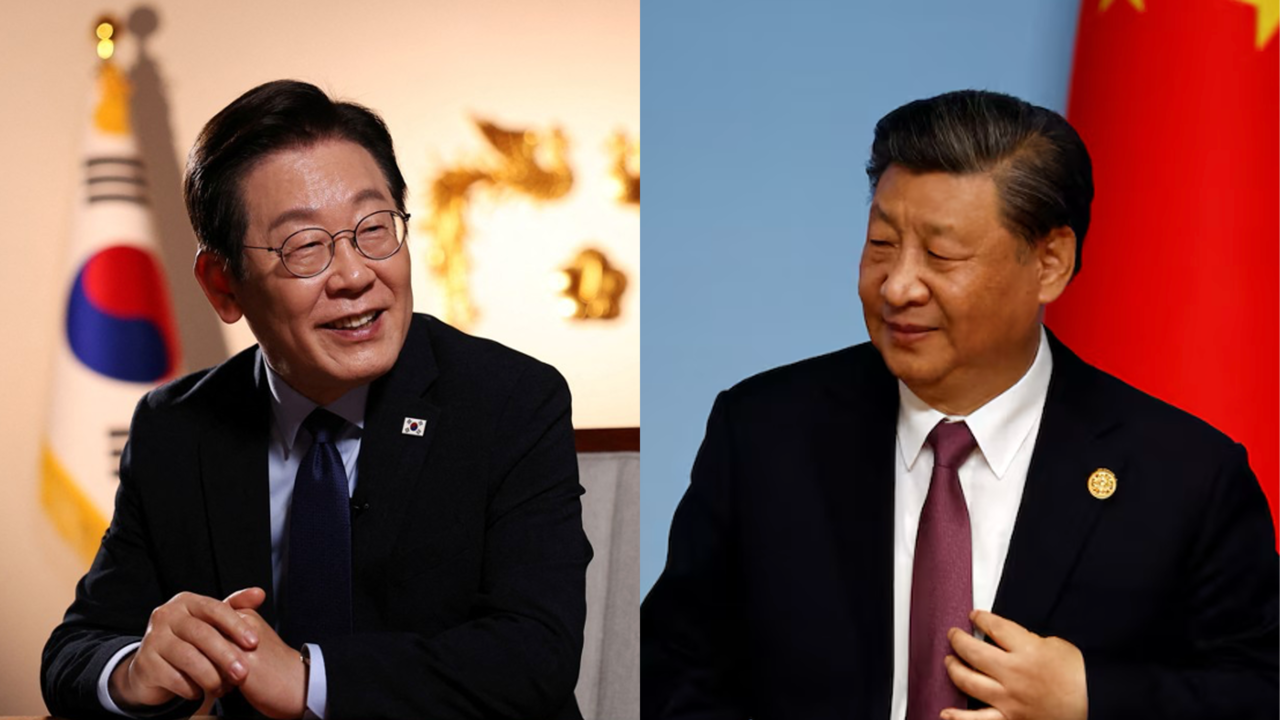
GYEONGJU, North Gyeongsang Province — South Korean President Lee Jae Myung said he would explore ways to further advance the strategic cooperative partnership with China ahead of his first summit with Chinese President Xi Jinping, who visited the country on Thursday as a state guest for the first time in 11 years.
“Together with President Xi Jinping, I will seek ways to further advance and sustain the mature development of the South Korea-China strategic cooperative partnership amid the rapidly changing domestic and international environment since the establishment of diplomatic ties,” he said in an interview with Xinhua News Agency released Thursday.
Expressing hopes for in-depth discussions with Xi on Saturday, Lee said he wishes to "expand channels for economic and trade cooperation negotiations and accelerate practical progress in the services and investment chapters of the South Korea-China Free Trade Agreement." He also said he aims to "establish a new institutional foundation for economic and trade cooperation" with Beijing through the summit with Xi, calling the neighboring leader's first visit since 2014 "significant."
Lee was referring to the two countries' strategic cooperative partnership, a nonbinding diplomatic framework signed in 2008 that was rebranded as an enriched strategic cooperative partnership in 2014, with both sides vowing deeper ties. He did not elaborate on how he plans to make the partnership more intensive.
Lee said that, regarding the Korean Peninsula, South Korea and China will strengthen strategic communication based on their shared interest in peace and stability. Though not directly mentioning North Korea, he said the two should work together toward denuclearization and lasting peace on the Korean Peninsula. He added that achieving a substantive resolution of the nuclear issue and building peace on the peninsula urgently requires China to play "a constructive role."
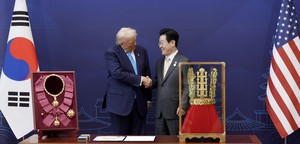
The interview was released hours before Xi arrived at Gimhae International Airport in Busan, where he was greeted with the highest honor by the South Korean government and held his first summit with US President Donald Trump in six years. It was their first encounter since June 2019, when they met on the sidelines of the G20 Summit in Osaka, Japan — and the first since Trump’s return to the White House in January.
Xi's three-day state visit coincides with the Asia-Pacific Economic Cooperation summit, which opens Friday in Gyeongju, North Gyeongsang Province. Lee is to hand over the APEC host role to Xi on the day they meet for a bilateral summit.
Xi’s visit to South Korea is his first since July 2014, when he met with then-President Park Geun-hye. Five months later, the two countries reached an understanding, followed by the signing of an agreement in June 2015, the 22 chapters of which encompass all areas of the two countries’ economies, including goods, services, investment, finance and telecommunications.
But bilateral ties started to strain after Seoul’s 2016 decision to deploy the US Terminal High Altitude Area Defense system. They have continued to deteriorate since. Beijing claimed the system’s radar could monitor China beyond North Korea, and subsequently imposed apparent economic and cultural sanctions on South Korea.
Relations were strained further under the previous Yoon Suk Yeol administration, as Seoul strengthened its strategic alignment with Washington and Tokyo amid a growing regional rivalry.
Xi’s trip follows his joint appearance with Russian President Vladimir Putin and North Korean leader Kim Jong-un at a military parade marking China’s Victory Day in September. The image of the Xi-Putin-Kim trio has fueled talk of an emerging bloc, increasing pressure on Seoul’s diplomatic balancing act.
In the Xinhua interview, Lee said he would be willing to visit China promptly if he had the opportunity to do so, stressing a need to "maintain strategic communication" between the two leaders through reciprocal visits.
Before his inauguration in June, Lee had visited China multiple times from 2016 to 2019, first as mayor of Seongnam, Gyeonggi Province, then as governor of the same province.
The interview was released in Chinese with the presidential office providing a Korean translation.
consnow@heraldcorp.com
flylikekite@heraldcorp.com