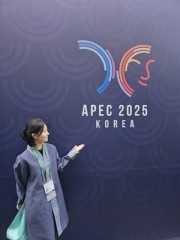
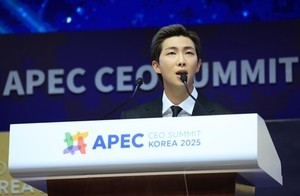
GYEONGJU, North Gyeongsang Province — Two decades after South Korea first hosted the Asia-Pacific Economic Cooperation conferences in Busan, the international event has returned — this time to Gyeongju, North Gyeongsang Province, a historic city just an hour’s drive north of Busan.
Back in 2005, South Korea was considered an East Asian economy striving to overcome the financial crisis that swept the Asian region in late 1990s.
Now, South Korea has risen to become a major economy. As of 2024, South Korea's gross domestic product stood at $1.88 trillion, up 136.9 percent from two decades ago, according to the International Monetary Fund.
The projections of how APEC conferences could boost local economies in 2005 and 2025 also indicate how the country's economy has grown.
According to a white paper for APEC 2005 Busan, the conference then fetched some 258.2 billion won ($180 million) in industrial output and generated 106.2 billion won in added value, while creating over 2,500 new jobs. For this year's event, according to the Korea Chamber of Commerce and Industry's projection, some 7.4 trillion won of output is expected and some 22,000 jobs will be created.
"South Korea is in a very different position in the world compared with 2005," Gerald McDermott, professor of international business at the University of South Carolina, told The Korea Herald. "South Korea is now a leader in many ways."
Moreover, South Korea built a creative economy powerhouse: It is already home to Netflix megahit "Squid Game," movies like "KPop Demon Hunters" and "Parasite," as well as trending K-pop numbers, dishes and beauty products. The country is also poised to show the world the strength and resilience of its democracy, which survived the political crisis triggered by former-President Yoon Suk Yeol's martial law imposition.
Looking beyond its economic and cultural prosperity, South Korea seeks to cement its position as one of the regional powers in Asia.
"With the US absent from the Trans-Pacific Partnership and appearing to waiver in its overseas commitments, APEC countries are turning to South Korea for leadership," said McDermott.
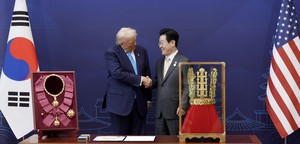
The country has also managed to build bridges connecting world superpowers, as the APEC conference is one of the few international events attended by both the US and China.
"The US-China bilateral relationship has always been important, but it is only now that China's relationship with third countries has become just as important to those states as their relationship to the US," Jeffery Robertson, associate professor of diplomatic studies at Yonsei University, told The Korea Herald.
North Korea now and then
Denuclearizing the North Korean regime has become a more distant goal than it was two decades ago, when the world saw progress in dealing with the North's nuclear facilities.
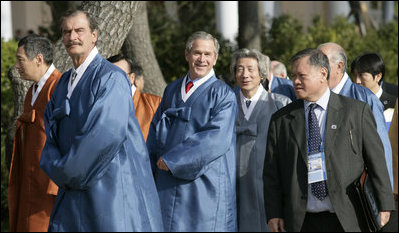
The APEC 2005 in Busan was held a couple of months after the fourth round of the Six-Party Talks, involving officials of the US, China, Japan, Russia and the two Koreas. The talks reaffirmed the goal of peaceful, verifiable denuclearization of the Korean Peninsula as enshrined in the joint statement released in September 2005.
As chair of the 2005 APEC conference — which hosted ex-US President George W. Bush, ex-Chinese President Hu Jintao, ex-Japanese Prime Minister Junichiro Koizumi and Russian President Vladimir Putin — then-President Roh Moo-hyun issued an oral statement about North Korea, which welcomed "the recent positive developments in the Six-Party talks towards verifiable denuclearization of the Korean Peninsula."
"We also encouraged further substantial progress in the Six Party Talks, in particular, the faithful implementation, in line with the principle of 'commitment for commitment, action for action' of the joint statement (in September 2005)," the statement continued.
The commitment among major powers, however, could not be kept. Just a year later, North Korea conducted its first-ever nuclear test in October 2006, after which the Six-Party Talks slowly faltered.
Little progress has since been made to contain the country's nuclear threat.
Over time, North Korea carried out six nuclear tests and launched hundreds of missiles in what appeared to be displays of power.
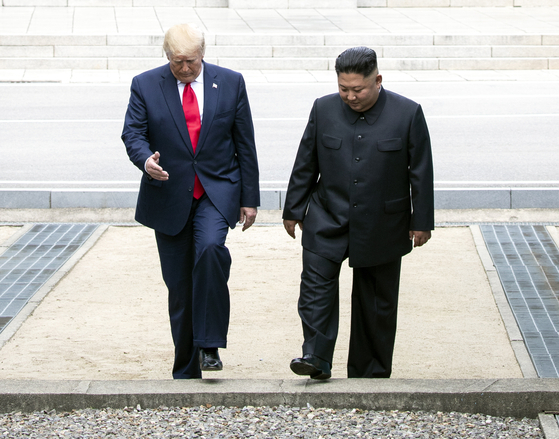
Though Trump met North Korea's Kim Jong-un three times in 2018 and 2019, Pyongyang's ties with Seoul appear to have reached their lowest point while he was away from the White House. North Korea designated South Korea as a hostile state last year through its constitutional amendment amid ex-President Yoon's hard-nosed approach to Pyongyang.
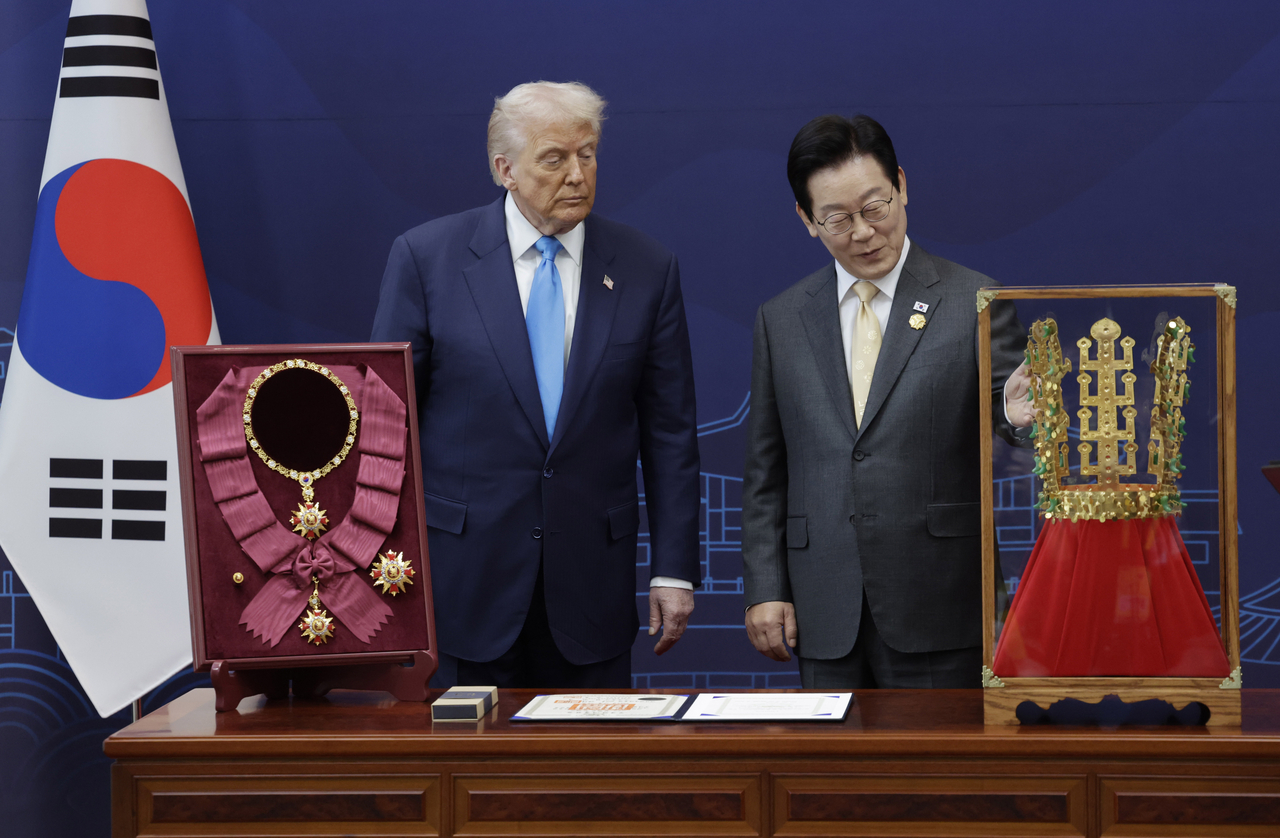
President Lee Jae Myung, who has taken conciliatory gestures toward the North, is expected to issue a statement on North Korea during the APEC week, but the chances of it serving as a breakthrough in handling related issues appear low.
"The role North Korea plays in international society, and its role vis-a-vis South Korea, has been remarkably consistent for the last 20 years," Robertson said.
"This consistency is the result of its nuclear arsenal. Whether this consistency is ideal for South Korea is another question."
What happened to trade liberalization?
Gone are the days when the world believed that trade liberalization was in sight.
At the Busan conference in 2005, the Busan Roadmap toward the Bogor Goals, also known as the midterm stocktake report, was adopted. That same year, APEC leaders called for a clear road map for the completion of multilateral negotiations related to the Doha Development Agenda led by the World Trade Organization in a standalone statement.
Today, such goals to promote free and open international trade have instead revealed that a long road lies ahead. Progress in DDA negotiations has stalled, and the Bogor Goals for the APEC members gave way to the Putrajaya Goals set for 2040, after reaching the deadline in 2020.
In addition, global trade protectionism resurfaced, primarily with Trump's comeback to the White House.
"Trade liberalization started eroding in the early 2000s with consecutive WTO Doha Round failures," Robertson said. "As we progress towards a new multipolar order, there will be different approaches towards trade, and whether APEC will play a role is dependent on its capacity to transform and adapt to this new era."
Meanwhile, the stakes for the APEC Summit itself are not high, as meetings of major powers steal the spotlight from APEC's main events.
"Trump's decision to skip the main sessions highlights that the forum has already become peripheral to the US-China relationship," Robertson said.
"We are not going back to the utopia of globalization, which was never realistic," McDermott said.
consnow@heraldcorp.com