North’s missile launch rebuffs Trump’s latest meeting offer but leaves door open: experts
US President Donald Trump said Wednesday that he and North Korean leader Kim Jong-un were unable to “work out timing,” indicating that a meeting between the two will not take place during his two-day visit to South Korea.
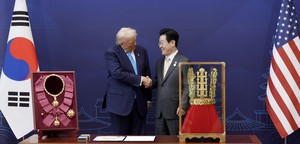
In his opening remarks at a summit with South Korean President Lee Jae Myung at the Gyeongju National Museum, Trump said, “I know Kim Jong-un very well. We get along very well. … We really weren’t able to work out the timing,” suggesting that a meeting during his stay was unlikely.
Trump arrived in the southeastern city of Gyeongju earlier in the day to attend Asia-Pacific Economic Cooperation meetings and a bilateral summit with Lee. His visit had fueled speculation that he might seek to resume personal diplomacy with Kim to revive stalled nuclear talks between Washington and Pyongyang.
“I know you are officially at war, but we will see what we can do to get that all straightened out,” Trump said, referring to the 1950-1953 Korean War ending in an armistice rather than a peace treaty. “We’ll have other visits and work very hard with Kim Jong-un and everyone involved to get things back on track.”
Just a day before Trump’s arrival, North Korea test-fired several sea-to-surface strategic cruise missiles into the West Sea, its first such launch in five months. According to the North’s state-run Korean Central News Agency, the missiles — believed to be improved variants of the Hwasal series — flew for about two hours and 10 minutes along a preset route before striking their target.
South Korea’s Joint Chiefs of Staff confirmed the launch Wednesday, saying it occurred around 3 p.m. Tuesday and that flight data was being analyzed jointly with US intelligence. “Our military maintains full readiness to respond overwhelmingly to any North Korean provocation,” the JCS said in a statement.
Pak Jong-chon, vice chairman of the Central Military Commission of the ruling Workers’ Party, oversaw the test, describing it as part of efforts to make the country’s nuclear forces “practical” and to strengthen its “nuclear combat posture.”
Analysts said the timing of the test — just as Trump reaffirmed his willingness to meet Kim — was deliberate. They viewed it as a calculated show of presence aimed at reminding Washington of Pyongyang’s military leverage while avoiding excessive provocation.
“North Korea is emphasizing its nuclear deterrence posture and signaling there will be no return to denuclearization talks,” said Yang Moo-jin, a professor at the University of North Korean Studies. “The launch is a message urging the US to recognize it as a nuclear-armed state and to end South Korea-US military drills.”
Yang noted that the North has recently tested missiles capable of reaching Gyeongju, including a hypersonic missile earlier this month, suggesting the launch was meant to draw attention during the APEC summit.
Another expert said the restrained nature of the test — involving cruise missiles not banned under UN Security Council sanctions and conducted without Kim’s presence — reflects Pyongyang’s dual-track approach: rejecting Trump’s overtures now while keeping diplomatic channels open for later.
“Kim Jong-un seems to be calibrating the level of provocation to maintain personal rapport with Trump,” said Lim Eul-chul, a professor at Kyungnam University’s Institute for Far Eastern Studies. “The launch reaffirms his rejection of Trump’s meeting proposals but also signals that future talks could resume at a time and under conditions Kim prefers.”
Lim added that by choosing cruise missiles over ballistic ones, Pyongyang moderated the level of confrontation. “Kim is sending a message that he’s rejecting an immediate meeting but not diplomacy itself,” he said. “He’s keeping the initiative, waiting for Washington’s next move.”
Trump’s visit, which runs through Thursday, coincides with the APEC summit in Gyeongju. He held his meeting with Lee on Wednesday afternoon and is set to meet Chinese President Xi Jinping on Thursday to discuss trade and regional security. Diplomatic sources said Washington and Beijing have tentatively agreed to delay planned tariffs and export controls to ease trade tensions.
Trump had repeatedly expressed interest in meeting Kim since the start of his second term in January. But North Korea has yet to respond publicly. Instead, its latest missile launch appeared to signal disinterest in a sudden summit, while preserving flexibility for future talks.
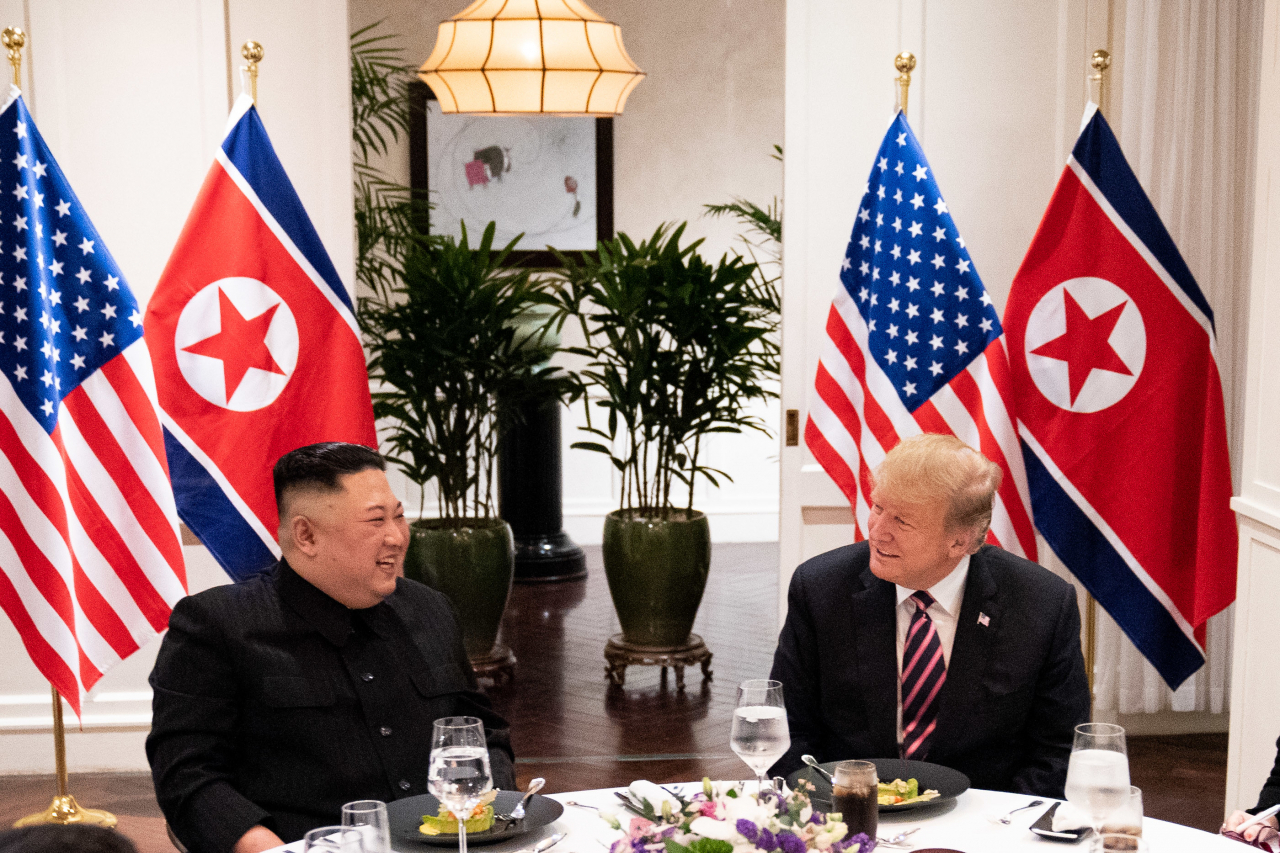
Kim, for his part, said last month that he remained open to another meeting with Trump — but only if the US abandoned what he called its “unrealistic” demand for denuclearization. “I still hold fond memories of President Trump,” Kim said, according to state media.
Experts say the combination of Trump’s remarks and Pyongyang’s missile diplomacy underscores the current stalemate — one defined not by hostility, but by each side waiting for the other to make the first move.
“North Korea is showing it won’t yield to pressure, but it hasn’t shut the door completely,” Lim said. “The message is clear: Talks will happen, but only when Pyongyang decides the timing and the terms.”
mkjung@heraldcorp.com