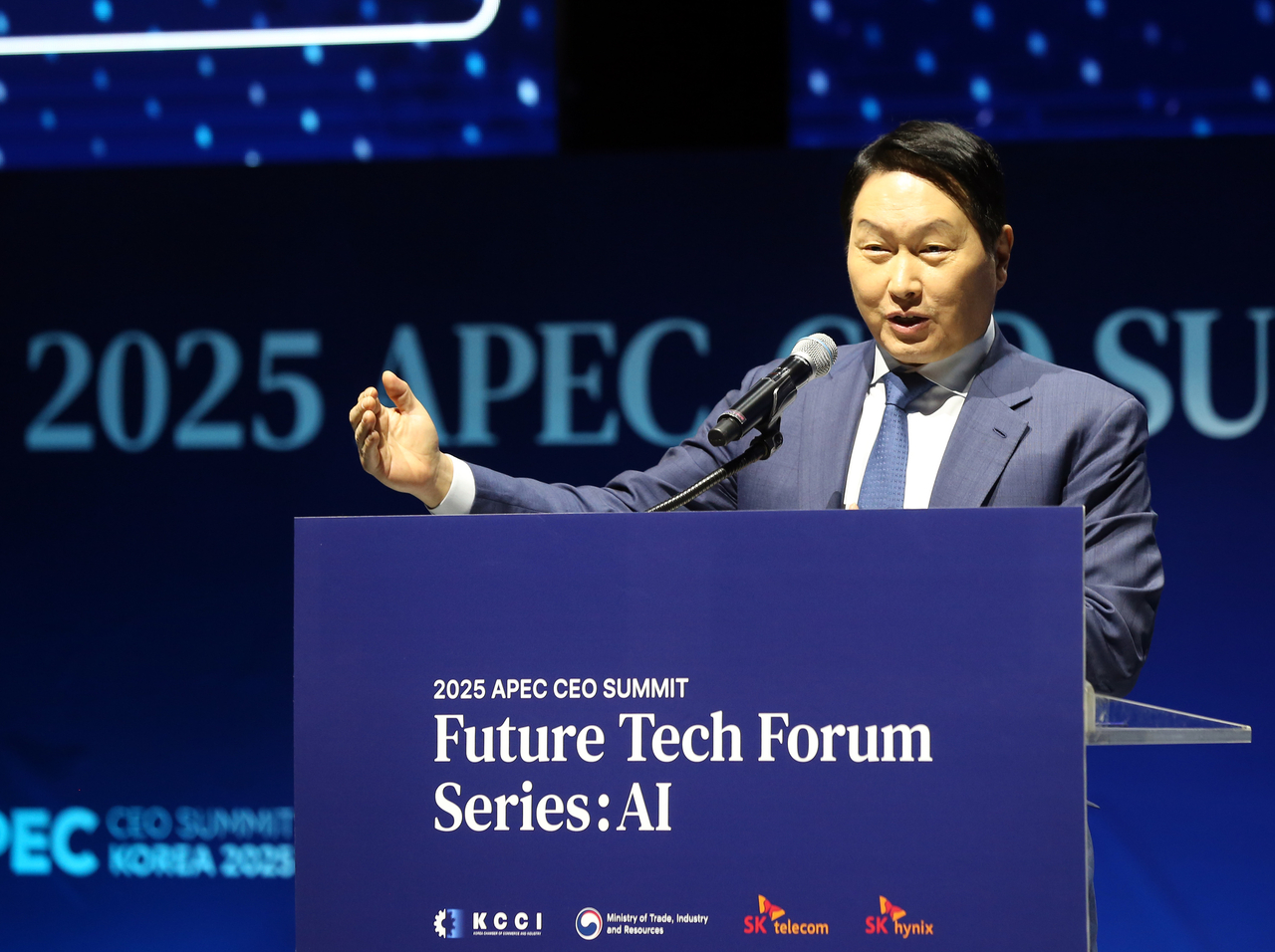
GYEONGJU, North Gyeongsang Province — Leaders of the global artificial intelligence industry on Tuesday highlighted South Korea’s efforts to stay ahead in the fast-evolving AI sector, with SK Group Chair Chey Tae-won saying the country’s agility and adaptability could help ease the “bottlenecks” constraining the industry’s growth.
Speaking at Future Tech Forum Series: AI, an official sideline event of the Asia-Pacific Economic Cooperation CEO Summit, Chey, who also heads the Korea Chamber of Commerce and Industry, noted that the breakneck pace of AI advancement is paradoxically generating new bottlenecks that limit further progress.
“Technologically, the world is transitioning from the ‘reasoning AI’ era to the ‘agentic AI’ era,” Chey said, adding that complexity is increasing as AI systems interact with each other to find solutions rather than humans interacting with AI. “Such rapid evolution is creating bottlenecks around the world.”
“We have to build many AI data centers, but everything that goes inside, from chips to energy, is facing bottlenecks,” Chey said. “I don’t think South Korea alone can resolve this bottleneck situation, but I am confident that Korea, with its ability to adapt rapidly, will become the test bed that helps resolve these challenges.”
The forum, organized by SK Group, brought together key AI figures from business, academia and government, including Ha Jung-woo, senior secretary to the president for AI and future planning; Matt Garman, CEO of Amazon Web Services; Choi Soo-yeon, CEO of Naver; Ryu Young-sang, president and CEO of SK Telecom; Kim Kyung-hoon, general manager of OpenAI Korea; Simon Milner, vice president of public policy for APAC at Meta; and Nitin Mittal, global AI leader at Deloitte.
Chey cited SK’s partnership with OpenAI and AWS as examples of “trust-based cooperation” that balance technological independence and global cooperation. SK is building a 100-megawatt hyperscale AI data center in Ulsan with AWS, and partnering with OpenAI to develop an AI data center in the southwest region of the country, as part of the Stargate project.
OpenAI Korea head Kim Kyung-hoon also emphasized that the ChatGPT-maker views South Korea as an ideal hub for AI innovation, with “world-class research and development capabilities and strong receptiveness to new technology.” Amid the US AI giant's efforts to double down on the region, OpenAI launched its Korean subsidiary in September, marking its third office in Asia and 12th globally.
Kim stressed the company’s deepening cooperation with major conglomerates — including Samsung Electronics and SK, as well as the Korean government — on AI infrastructure is part of Seoul’s push for a “sovereign AI" initiative.
“Sovereign AI should not be defined by competition alone,” Kim said. “It should mean strengthening the domestic AI ecosystem through collaboration.”
AWS CEO Matt Garman also echoed that AI development is inherently global, requiring cooperation across multiple countries and industries.
“When you look at a technology stack, no one AI stack can be built in any one country,” said Garman. “We need foundries and TSMC, we need memory and HBM that’s built here in Korea, and we need cloud technologies from the United States. If you look at all the pieces that go into building a critical AI stack, it’s a global economy and a global technology stack.”
Still, he said AWS sees value in strengthening local infrastructure, part of the reason the company is working with SK Group to build an AI data center in Ulsan. The facility is part of AWS’s broader $50 billion investment in the Asia-Pacific region, aimed at expanding data, computing and AI capabilities.
“Investments in these AI data centers are not cheap,” Garman said. “And as a company, we've made huge capital investments all throughout the APEC region to make sure that everybody has access to this, and we've also committed to that.”
sahn@heraldcorp.com