Lee says S. Korea to remain in US-led framework, maintain practical China ties
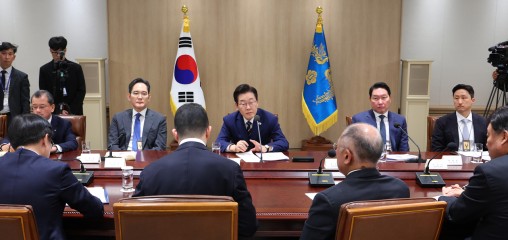
South Korean President Lee Jae Myung on Tuesday pledged to boost defense spending, vowing a more proactive role for Seoul in its alliance with the United States in President Donald Trump's second term.
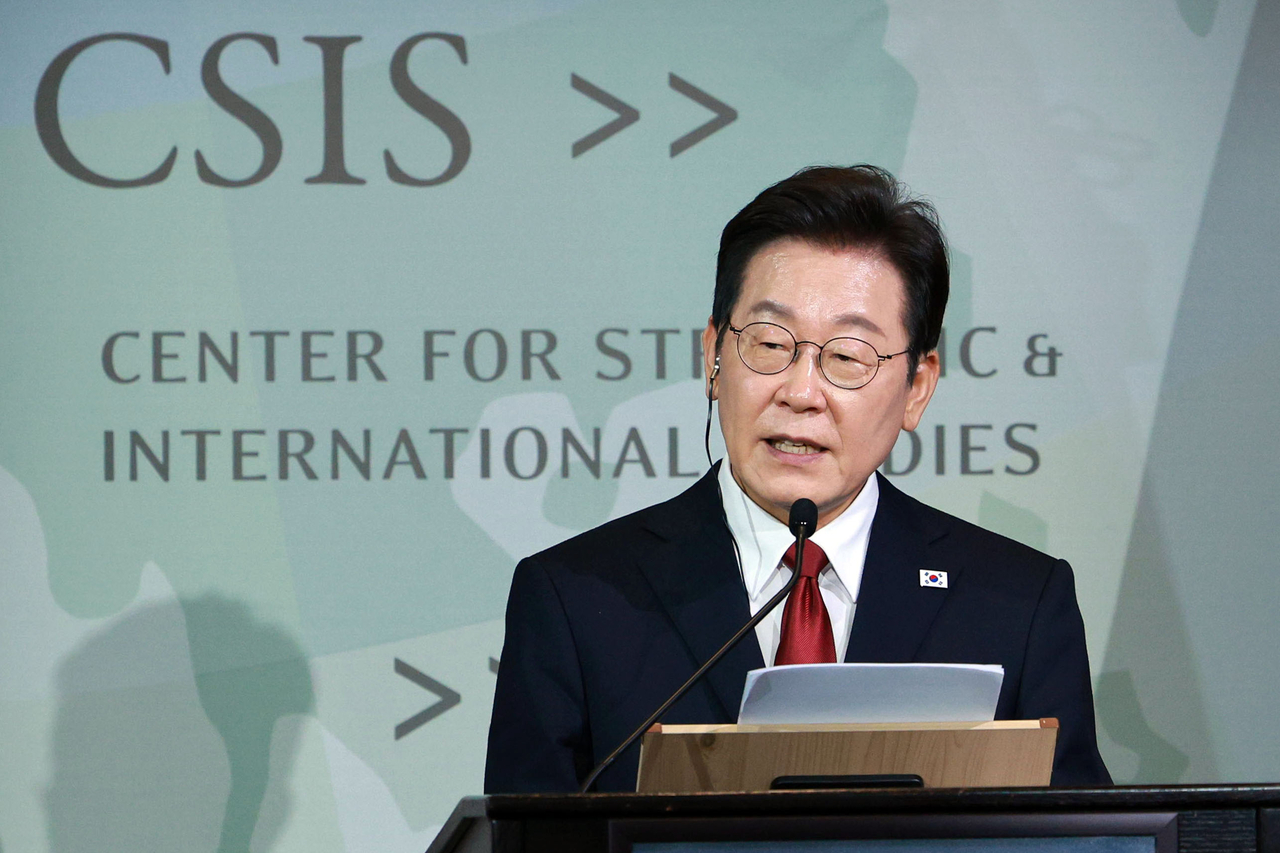
In a speech at the Statesmen’s Forum hosted by the Center for Strategic and International Studies in Washington, Lee said his administration would build a "smart, elite military" to address 21st-century security challenges, stressing that Korea’s defense commitment to the alliance would remain ironclad.
"Through my summit with President Trump, we agreed to modernize the Korea-US alliance in line with the changing security environment and to open a new chapter centered on advancing our national interests," Lee said. "Our combined defense posture and Korea’s contribution to regional stability will grow stronger through greater investment."
Lee said Trump also expressed strong support for Seoul’s efforts to bolster its defense capabilities, including expanding cooperation in advanced defense technologies and industries.
Lee reaffirmed South Korea’s commitment to denuclearization and the Treaty on the Non-Proliferation of Nuclear Weapons, calling the North’s nuclear issue "an unresolved legacy of the past."
"The Korean Peninsula’s adherence to denuclearization is crucial for global peace and aligns with the interests of both Koreas," he said.
Lee emphasized the importance of deepening cooperation in high-tech sectors to advance mutual prosperity between South Korea and the United States. He said Korea’s global competitiveness in shipbuilding and semiconductors could serve as a catalyst for shared growth.
"K-shipbuilding will lead the renaissance of American shipbuilding," he said, adding that tariffs would serve as a pump primer for technological collaboration.
Lee also stressed the importance of trilateral coordination with Japan in responding to North Korea’s provocations and ensuring Indo-Pacific stability. He referred to Japan as "a neighbor with whom we share the same yard," adding, "We’re witnessing the Korea-US alliance flourish and Japan is an indispensable partner in that journey."
Lee closed his speech by expressing optimism about the future of the alliance, echoing the military slogan: "We go together."
"The golden era of the Korea-US alliance has yet to come — not because we lack anything, but because there is still so much we can achieve together," he said. "If we stay united, we can accomplish even greater things. We go together."
The speech came after Lee's first summit with Trump and was followed by a brief interview session with CSIS President John Hamre.
Asked about Seoul’s position between the US and China, Lee acknowledged Korea’s past dual-track approach — relying on Washington for security and Beijing for trade — but said that paradigm no longer holds.
"As the global supply chain realigns and US policy toward China becomes more defined, Korea cannot maintain the same stance as before," he said. "We remain within the US-led framework, while maintaining only essential, practical ties with China due to our proximity."
On managing tensions with North Korea, Lee said sanctions alone have failed to halt Pyongyang’s weapons buildup, calling the North a "poor but fierce neighbor."
"In just a few years, the number of nuclear warheads North Korea holds has more than doubled, and its capability to produce fissile material has grown dramatically," he said. "They are now one step away from completing reentry technology for intercontinental ballistic missiles and may soon be capable of striking the US mainland."
Lee said strong deterrence must remain in place, but added that proper management measures are necessary to prevent further escalation.
"We must not allow the situation to worsen. With the right mechanisms, we may be able to halt further development and ensure that North Korea’s capabilities do not become a direct threat to the American people."
When asked how he could be a unifying president in a time of deep political division, Lee — who took office in early June following the impeachment of former President Yoon Suk Yeol over his declaration of martial law in December 2024 — pointed to the strength of South Korea’s democracy and its history of peaceful political change.
"In Korea, tens or even hundreds of thousands of citizens have gathered in protest — without fire, destruction or violence," he said. "Twice in eight years, political power was overturned not by force, but through song and dance. There is no other country in the world with such a record."
"Leadership in divided times means not drawing lines or building walls," Lee continued. "It means meeting people where they are and continuing the conversation. If those efforts are made sincerely, these challenges can absolutely be resolved — at least in South Korea."
flylikekite@heraldcorp.com